
AI in Ecommerce Analytics: The Rise of Predictive Analytics and Personalization
Growth in ecommerce has moved past reporting only what has happened. The most successful progressive teams now require systems that can identify future steps and how to implement them. Traditional ecommerce analytics and reporting remain important, but they do not address the dynamic demand and rising acquisition costs businesses face today.
A McKinsey & Company study shows that although organizations are gathering much more data than ever, most struggle to implement the strategies needed for instant decision-making. Also, Gartner predicts that by 2027, 50% of business decisions will be augmented or automated by AI, highlighting a very popular shift toward predictive and prescriptive analytics models.
Data analytics for ecommerce is always improving, giving businesses more opportunities to fully optimize their strategies. Predictive customer analytics and AI-based solutions allow teams to predict possible demand while personalizing experiences on an as-and-when basis. Rather than standard fixed dashboards, decision-makers within brands receive proactive insights that directly influence pricing, inventory, and marketing decisions.
The question you may now face is not whether to invest in ecommerce data analytics, but how to use the right combination of tools to help your brand move from foresight to insight to action.
Not sure where to start? Explore top ecommerce development companies to find the right technical partner for your stack.
What Is Ecommerce Analytics Today?
Ecommerce analytics is the process of gathering, quantifying, and interpreting data from online stores to understand performance and inform business decisions. It encompasses all aspects of how users find a site, navigate it, purchase, and return.
At a fundamental level, numerous teams use tracking tools to monitor activity and generate reports. This involves traffic sources, page views, and sales totals. Although helpful, this form of tracking is mostly descriptive; it describes what has occurred, but not why or what to do next.
More sophisticated ecommerce data analytics goes beyond that. It links data across channels, customers, and products to identify patterns and performance drivers. This involves segmenting high-value customers, identifying funnel drop-off points, and linking marketing expenditure to revenue performance. It is not only about visibility, but also about improved decision-making.
The following metrics are typically followed by most ecommerce teams:
- Conversion rate
- Average order value (AOV)
- Customer acquisition cost (CAC)
- Return on ad spend (ROAS)
- Customer retention rate
- Churn rate
- Repeat purchase rate
These metrics constitute the basis of ecommerce performance analytics. They help teams assess channel growth, efficiency, and customer loyalty.
Nevertheless, numerous brands still cannot convert insight into action. Dashboards are commonly divided across platforms, data is lagging or incomplete, and teams are more focused on reporting than on optimization. Consequently, decisions are reactive rather than proactive, and opportunities to enhance conversion, retention, and profitability are lost.
This is driving a shift toward in-depth analytics solutions, including automation, forecasting, and AI-based models.
How AI Is Transforming Ecommerce Performance Analytics

AI redefines how different ecommerce teams measure and act on performance analytics. Traditional analysis depends on your brand's manual workflows, limited datasets, and delayed reporting cycles. Whereas AI enables continuous analysis, deeper insight, and immediate action.
What’s Changing
From limited to large-scale analysis
AI can process far more behavioral, transactional, and contextual data than manual analysis ever could.
From visible trends to hidden patterns
Machine learning identifies correlations and indicators that humans often miss.
From delayed insights to real-time action
Live data can be used to make real-time decisions, rather than relying on weekly reports.
From reactive reporting to proactive optimization
Teams are not concerned with explaining results but rather with enhancing outcomes.
Key AI Capabilities in Ecommerce Analytics
Machine learning
Powers forecasting, pattern recognition, predictive customer analytics (e.g., churn risk, purchase likelihood).
Natural language processing (NLP)
Transforms complicated ecommerce reporting into concise summaries and actionable insights.
Generative AI in ecommerce
Supports:
- Marketing content and product descriptions.
- Customer segmentation and targeting
- Interpretation of analytics into recommended actions
What This Looks Like in Practice
Rather than looking at a dashboard when performance declines, AI-based ecommerce analytics can:
- Detect a decline in conversion rate in real time.
- Determine the underlying cause (e.g., reduced interaction on mobile product pages).
- Suggest or initiate actions (e.g., modify content, offers, or targeting).
Example
A retailer uses AI to monitor on-site behavior. The system recognizes users likely to leave their carts based on their browsing patterns and timing.
- Personalized offers are activated immediately.
- Real-time product recommendations.
- Generative AI in ecommerce generates personalized messages to each segment.
The outcome: increased conversions without manual analysis, powered by sophisticated ecommerce analytics tools.
The Rise of Predictive Customer Analytics in Ecommerce

Predictive customer analytics is taking center stage in the way ecommerce businesses are growing. Simply put, it uses data to predict what customers are likely to do next, whether to make a purchase, abandon a cart, or return to make another purchase.
In contrast to traditional analysis, which focuses on past performance, predictive models use both historical and real-time data to predict future behavior. This involves browsing history, buying history, interaction patterns, and external indicators. With machine learning, ecommerce data analytics is no longer about explaining but predicting.
The business value is short-term. The teams can move faster, stay more focused, and allocate resources more effectively across marketing, sales, and operations.
Common Predictive Use Cases
Contemporary ecommerce analytics systems facilitate various predictive uses:
- Purchase likelihood prediction: Score users based on their probability to convert
- Churn and retention forecasting: Find at-risk customers.
- Customer lifetime value (CLV) estimation: Highlight high-value users and guide budget allocation
- Product recommendation modeling: Provide relevant recommendations based on behavioral and similarity patterns.
- Demand forecasting: Anticipate sales patterns to streamline inventory and supply chain choices.
- Cart abandonment prediction: Intervene before users drop out of the funnel.
Why It Matters to Growth
Predictive capabilities directly impact performance across key areas of ecommerce performance analytics:
- Focuses on high-value audiences: Target customers with the highest likelihood of conversion or long-term value.
- Minimizes wasted ad spend: Allocate the budget according to expected results rather than mass targeting.
- Enhances campaign timing: Activate emails and CRM activities based on anticipated behavior rather than on a schedule.
- Facilitates accurate personalization: Customize experiences across channels with real-time intent signals.
Consequently, ecommerce reporting is less concerned with the past performance and more focused on future decision-making.
Personalization at Scale – AI Making It Real
Ecommerce personalization has gone way beyond simple product recommendations. According to GWI's retail trends research, consumer expectations around digital experience continue to rise, making AI-driven personalization a competitive necessity rather than a differentiator.
Nowadays, it influences the whole customer experience, including what is displayed on the homepage and when they get an offer. This is enabled by AI, which transforms insight into action at scale and speed.
The most important sector is improved ecommerce data analytics. Personalization is only partial and inaccurate without precise, linked data. Through it, brands can provide dynamic experiences that capture each customer's behavior, intent, and value.
If your platform limits data integration, consider re-platforming with one of the leading ecommerce development companies.
This is made possible by AI through predictive customer analytics and real-time decision-making. Predictive models determine what a customer is likely to do next. Personalization systems then respond to that insight- personalizing content, offers, and messaging in real time.
Example:
A repeat customer visits an ecommerce site after window shopping for premium products in previous visits. According to the forecasted intent, the homepage displays high-quality products, time-sensitive deals, and loyalty programs. A new visitor, in turn, will be shown bestsellers, introductory discounts, and a wider category navigation. The same ecommerce analytics is used in both experiences, but in real time to optimize relevance and conversion.
Where Personalization Happens
Personalization with AI is applied to all key touchpoints of contemporary ecommerce performance analytics:
- Product recommendations: Dynamic recommendations on the basis of behavior and similarity patterns.
- Individualized search and merchandising: Search results and category pages prioritized by user intent.
- Customized email sequences: Predictive-based automated campaigns based on actions and lifecycle stage.
- On-site messaging: Prompts, offers, or content in real time, depending on session behavior.
- Promotional timing: Discounts and incentives are offered when the conversion probability is highest.
- Loyalty and retention campaigns: Special incentives and re-engagement of high-value customers.
What Data Drives Personalization?
Successful personalization of your brand requires various data inputs in ecommerce analytics tools:
- Browsing history: This shows all browsing history, pages visited, and the amount of time spent on each specific page.
- Purchase history: All data from what has been purchased, how often, and the amounts.
- Channel and device behavior: This Displays variations in mobile, desktop, email, and all paid channels.
- Engagement data: Clicks, opens, and interaction patterns across touchpoints.
- Demographic or geographic inputs: Regional trends and location preferences.
- Real-time intent signals: Behavior during the current session, e.g., search queries or cart activity.
When these data sources are combined, personalization becomes more accurate and scalable. Brands can react to personal intent in the moment, rather than to fixed segments.
This is where generative AI in ecommerce adds value. It can automatically generate and customize content, such as product descriptions, email copy, and promotional messages, to fit each segment or user profile. This, together with predictive models, guarantees that the message and timing are optimized.
The outcome is a direct correlation between analytics and revenue. Personalization is no longer a single strategy but rather the implementation level of contemporary reporting and decision-making.
From Ecommerce Reporting to Actionable Intelligence
Conventional ecommerce reporting is based on snapshots. Weekly or monthly reports provide an overview of activity across channels, campaigns, and products. Although they can be helpful for performance tracking, they are usually slow to generate and offer limited explanations. Teams waste time in data compilation rather than taking action.
AI changes this model. It simplifies reporting and makes it more interpretive and decision-oriented. Teams do not need to go through dashboards and draw conclusions manually; they can trust systems that process data in real time and present the most important information.
Fundamentally, AI transforms ecommerce analytics into a decision-support layer. It does not merely give numbers, it describes trends, points out risks, and suggests measures.
How AI Improves Ecommerce Reporting
AI improves reporting in various important fields of ecommerce data analytics, these are as follows:
- Automated report generation: Reports are generated automatically, saving time on data preparation.
- Real-time anomaly detection: AI systems can detect abnormal performance changes in real time, not after the fact.
- Plain language trend summaries: Insights are converted to simple plain language, so they are easier to understand.
- Forecast-based reporting: Reports contain future projections, not only historical information.
- Quick cross-channel analysis: Multiple sources of data are combined and analyzed in near real time.
These capabilities shift reporting from a passive activity to an active part of ecommerce performance analytics.
What Better Reporting Looks Like
AI-based reporting is not only about metrics but also context. Teams receive a more in-depth understanding of what is driving performance, rather than superficial updates.
Rather than: Sales fell 12%.
AI-based insight: Sales decreased by 12 percent among mobile users in paid social traffic, likely due to reduced product page views.
An in-depth report can shed light on teams that convert initial insights into actionable tasks. Optimization is not the goal, but a starting point. AI can also suggest next steps to help your brand grow efficiently. Depending on the patterns, systems can propose adjustments to campaign targeting, enhancements to product pages, or budget reallocation to more successful channels. This can bridge the gap between analysis and execution.
As a result, ecommerce analytics tools are no longer just reporting platforms; they become engines for continuous improvement. Teams take less time to interpret data and more time to take action, and have more directed and faster feedback loops.
Top Ecommerce Analytics Tools Powering This Revolution
The current market for ecommerce analytics tools is fragmented. Various tools address different issues: attribution, customer intelligence, BI, and AI-driven personalization. As a buyer, the most important thing is to know which category best suits your current maturity and growth objectives.
The following is a practical breakdown of the categories, showing where each tool is most suited.
All-in-One Ecommerce Analytics Platforms
These platforms combine attribution, customer analytics, and reporting into a single environment. They are meant to minimize fragmentation and provide teams with a cohesive picture of performance.
Klaviyo
Mainly email and SMS, but also offers robust in-built analytics of customer behavior, segmentation, and lifecycle performance.
Best use: Brands that are retention-oriented, CRM-focused, and owned-channel.
Glew.io
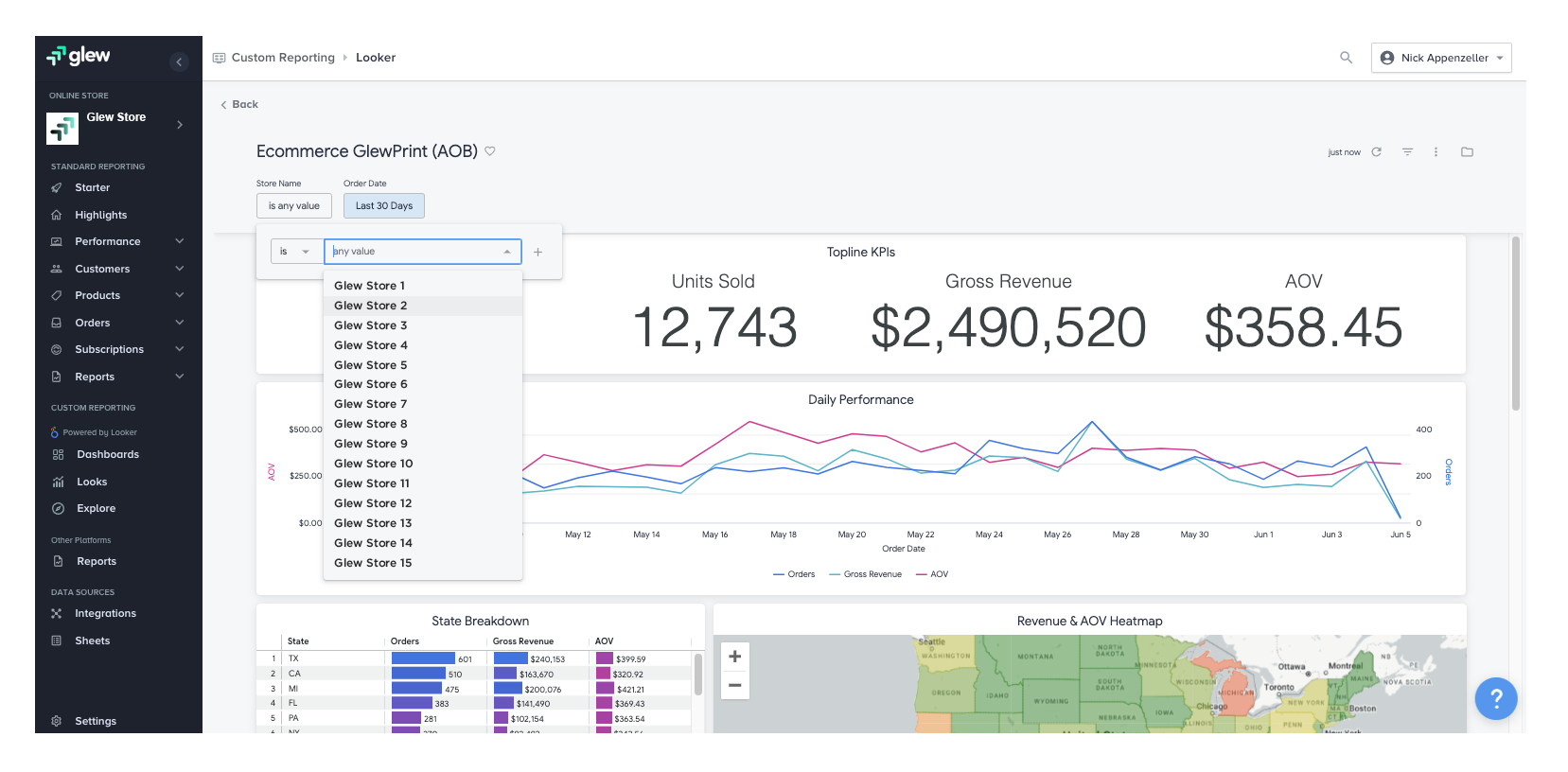
An analytics platform that includes LTV, product performance, and segmentation pre-built reports. It integrates ecommerce, marketing, and operational data into a single system.
Best use: Mid-sized brands that require plug-and-play reporting without extensive configuration.
Triple Whale
An analytics and attribution platform that is Shopify-specific and consolidates ad, store, and customer data into a single dashboard with a heavy focus on profit and ROAS tracking.
Best use: DTC Shopify brands with paid media at scale.
Northbeam
An improved attribution platform with machine learning to trace the complex, multi-channel customer paths and tie ad spend to revenue.
Best when: The brand and agency have large ad budgets and are growing rapidly.
Predictive & AI-Native Tools
These platforms are built on AI, focusing on personalization, forecasting, and real-time decisioning rather than mere reporting.
Bloomreach
Combines AI-driven search, personalization, and merchandising with predictive models.
Best when: Enterprise ecommerce teams need to focus on personalization at scale.
Dynamic Yield
Concentrates on real-time optimization of experience on web, app, and email with machine learning.
Best use: Brands that want to implement advanced experimentation and personalization programs.
Segment
https://www.twilio.com/en-us/segment
A customer data platform that unifies data and enables downstream personalization, analytics, and AI use cases.
Best use: Teams developing a centralized data layer to predict customer behavior.
BI & Visualization Tools
These are not e-commerce-specific tools, but are commonly used to create custom dashboards and additional analysis layers.
Looker
https://cloud.google.com/looker
An effective BI tool (as a part of Google Cloud) to create custom data models and dashboards.
Best use: Data teams that require complete control over ecommerce data analytics.
Tableau
Reputed to have high visualization and exploration of large datasets.
Best use: Businesses with complicated reporting and visualization requirements.
Google Looker Studio
https://cloud.google.com/looker-studio
A lightweight, free dashboarding tool that can be linked to various data sources.
Best when: Smaller teams or marketing teams that require easy access to reporting.
Generative AI & AI-Enhanced Analytics
Generative AI is now a feature of many modern platforms in ecommerce beyond dashboards:
- AI-generated reports and summaries (natural language insights)
- Automated audience creation and segmentation.
- Creation of content (product descriptions, email copy, ad variations)
- Performance-based predictive recommendations.
Different AI tools, such as Triple Whale and Bloomreach, are used to integrate AI directly into personalization and content delivery for firms. Assisting your business with efficient content rollouts and the maximization of your brand's potential reach
How to Choose the Right Category
- All-in-one platforms are recommended when you need rapid deployment and a single source of truth.
- Personalization and prediction are your priority; use AI-native tools.
- BI tools should be used when you require flexibility and custom analysis across systems.
- Automated insights and quicker decision-making: use AI-enhanced tools.
For most teams, a hybrid stack is the way to go. It is not about having more dashboards, but about a system in which ecommerce analytics drives action, not just visibility.
Top Features to Look for in Ecommerce Analytics Tools
Ecommerce analytics tools are not all the same. Some of them do not really help you make decisions. They focus heavily on dashboards and visualizations, but offer limited support for decision-making. This does not give you the necessary assistance to take action. When you are buying one of these tools, you should pick the ones that help you make decisions faster and better, not ones that show you numbers.
Newer ecommerce analytics tools are improving. They can do things automatically, predict what will happen, and give you information in time. They feature analytical tools that leverage intelligence to identify unusual patterns and predict future events. These features are becoming normal in the ecommerce analytics tools.
Must-Have Capabilities
When evaluating ecommerce analytics tools, consider these features. These features are what make a good tool great:
- Real-time dashboards and alerts: This means you can see how your brand is doing now and receive warnings if anything unusual happens.
- Predictive modeling: This means the tool can predict what your customers will do, how much money you will make, and what people will want to buy.
- Customer segmentation: Grouping your customers based on what they do, how much they spend, and what they want. This helps you target the people and give them what they want.
- Cohort analysis: shows how different customer groups behave over time. You can see if they come back, how much they spend, and if they buy again.
- Attribution support: This means you can see which advertising and marketing strategies work and which do not.
- Revenue and retention forecasting: This means you can predict how much revenue you will generate and how many customers you will retain.
- Generated insights or summaries: This means the tool can automatically tell you what is important, what is strange, and what you should do.
- Integrations across the stack: This means the tool can work with all the tools you use, such as your platform, customer relationship management system, advertising platform, and email tool.
These features are what make a good ecommerce analytics tool great. They help you go from looking at numbers to really understanding your ecommerce business.
What This Means for Buyers
The difference between ecommerce analytics tools is not just about how they look. It is about how they help you make decisions.
Strong platforms:
- Reduce the amount of work you have to do to understand your data.
- Automatically shows you what is important.
- Help you turn insights into action.
Weaker platforms:
- Make you work hard to understand your data.
- Spread your data across systems.
- Slow down your decision-making.
As ecommerce analytics tools improve, people expect more from them. They should not just give you information; they should help you make decisions. Ecommerce analytics tools should guide you, not inform you.
Challenges and Considerations
AI-driven ecommerce analytics delivers value. Buyers should know the key limitations before investing.
Data Compliance
Regulations such as the General Data Protection Regulation and the deprecation of cookies limit tracking. They require first-party data strategies.
Data Quality Issues
Inaccurate data or incomplete data decreases the precision of ecommerce data analytics. It also undermines customer analytics.
Data Silos
CRM, ads, and ecommerce systems result in fragmented insights and reduce the effectiveness of ecommerce performance analytics.
Implementation Risk
Wrong configuration or incompetence may result in misleading recommendations. It may also constrain the payback.
AI Lack of Transparency
Biased data can be reflected in AI models. They can be hard to decipher in complicated ecommerce systems.
Cost and Complexity
Advanced ecommerce analytics tools require investment. They need integration and ongoing management.
Over-Personalization
Excessive targeting can feel intrusive. It reduces customer trust.
Overall
The bottom line is that AI improves ecommerce reporting. It also improves decision-making. It only works when supported by clean data. It needs implementation and responsible use. Ecommerce analytics and AI are tools. Buyers must be aware of their limitations.
Building an AI-Powered Analytics Strategy – Practical Steps
Implementing AI in ecommerce analytics requires a systematic approach. The aim is to shift towards fragmented data and reactive reporting to data-driven decision-making.
1. Audit Your Existing Data Infrastructure
Start with what you have. Evaluate data quality, accuracy, and completeness between systems. It is better to have clean, reliable data than to have large amounts of unusable data.
2. State the Business Questions
Focus on results, and not the instruments at hand. Determine the most important business questions to ask, such as churn risk, customer lifetime value, and campaign performance.
3. Improve Data Quality and Integration
The integration of information on ecommerce sites to improve customer relationship management, advertising networks, email tools and organic search channels. Partnering with an SEO service agency can help ensure your organic traffic data is properly tracked and fed into your analytics stack. Powerful data analytics relies on a strong, linked perspective of the customer's journey.
4. Select Tools that suit your Scale
It is crucial to pick ecommerce tools based on your brand’s size, technical capabilities, and goals. Do not over-engineer; select systems you can implement and use that fit your brand's role in the market.
5. Start with One High-Impact Use Case
Target a high ROI use case, like churn prediction, product recommendations, or audience targeting. This helps demonstrate value quickly and secure internal buy-in.
6. Develop a Feedback Loop
AI models become better with time. Provide them with new information regularly, track strategy performance, and optimize different techniques to improve customer predictive analytics.
7. Automate and balance with human control
Use intelligence to speed up analysis, but always check the results with a human to ensure they are correct. This step helps with managing risks. Make sure all the information you get is useful for your business.
8. Measure Outcomes and Refine
Evaluating results and optimizing strategies based on data is essential if you want your brand to grow. Many systems will need to be adjusted, and you will need to monitor factors such as how many people buy and how many return. It is really important that your organization uses systems that adapt to your needs based on data, so you can improve your store over the long term.
Conclusion
Overall, artificial intelligence is not replacing ecommerce analysts. Instead of being a solidified replacement for analysts, it helps them complete tasks with better outcomes and greater certainty. AI uses the combination of customer data, instant information, and personalized recommendations. This helps companies move efficiently, target the right potential buyers, and improve the customer experience.
Looking ahead, analytics are moving toward autonomous decision-making, where agentic AI continuously monitors performance, predicts trends, and recommends or executes actions without constant human intervention. Organizations that embrace this evolution early will be positioned to lead in efficiency, personalization, and growth, turning data from a historical record into a strategic engine for future success.
FAQs
What is ecommerce analytics?
Ecommerce analytics is, in essence, collecting data from your store, then measuring and interpreting it to improve your business.
What is the best analytics for ecommerce?
The best analytics are tools that provide real-time reports, predict future outcomes, and offer guidance on what to do, and they should be right for your business size.
What is predictive customer analytics in ecommerce?
Predictive customer analytics in ecommerce uses intelligence to predict how differently customers will behave, so you can do things like retain customers, group them, and suggest products.
How does generative AI in ecommerce support personalization?
Generative AI in ecommerce supports personalization by creating content, writing product descriptions, and crafting ads tailored to how customers are predicted to behave.
How is data analytics used in ecommerce?
Data analytics is used in ecommerce to track performance, improve campaigns, predict what people will want, personalize experiences, and support business decisions.


