Main Marketing Channels of IT Services Companies in 2026
Like many industries, the IT services market has been seeing significant change since the emergence of AI. Besides affecting how businesses market themselves, this robust, well-funded technology is revamping the entire competitive landscape.
For a third year, Techreviewer has carried out a comprehensive survey identifying the most effective digital marketing methods for IT companies and examined how market conditions, buyer behavior, and emerging AI-driven channels are shaping the IT services market in 2026.
To see research results from 2025 and 2023, follow these links:
For companies comparing outside marketing partners, Techreviewer also provides rankings of Top Digital Marketing Agencies and Top SEO Agencies.
The most significant takeaways from this survey include:
- Content marketing and SEO were the most effective marketing channels for IT services companies in 2026, followed by AI search and generative engine optimization, referral platforms, and referrals.
- Increased competition from AI-native competitors is the biggest perceived threat to IT services companies in 2026.
- AI is rapidly influencing how IT services companies attract customers, how their buyers evaluate providers, and how these companies assess future competitive threats.
- IT services companies stated that generating leads has been the biggest challenge in acquiring customers. So has rising competition, long sales cycles, and the challenge of closing deals.
Understanding which marketing channels are the most effective and how AI is reshaping the industry will be critical to every company’s direction as the year progresses. Marketing strategy for IT services companies is changing quickly, and there’s little room for tactics that don’t match how buyers choose providers.
Methodology
The data in this report is based on a survey conducted by Techreviewer in April 2026. A total of 101 IT services companies participated, representing a broad cross-section of IT service providers by size, geography, and service model.
Respondents were sourced from Techreviewer's platform database of verified IT services companies. Each participant completed a structured questionnaire covering marketing channel usage, budget allocation, customer acquisition challenges, competitive perception, and planned investments for the next 12 months. All responses were collected anonymously to encourage candid answers.
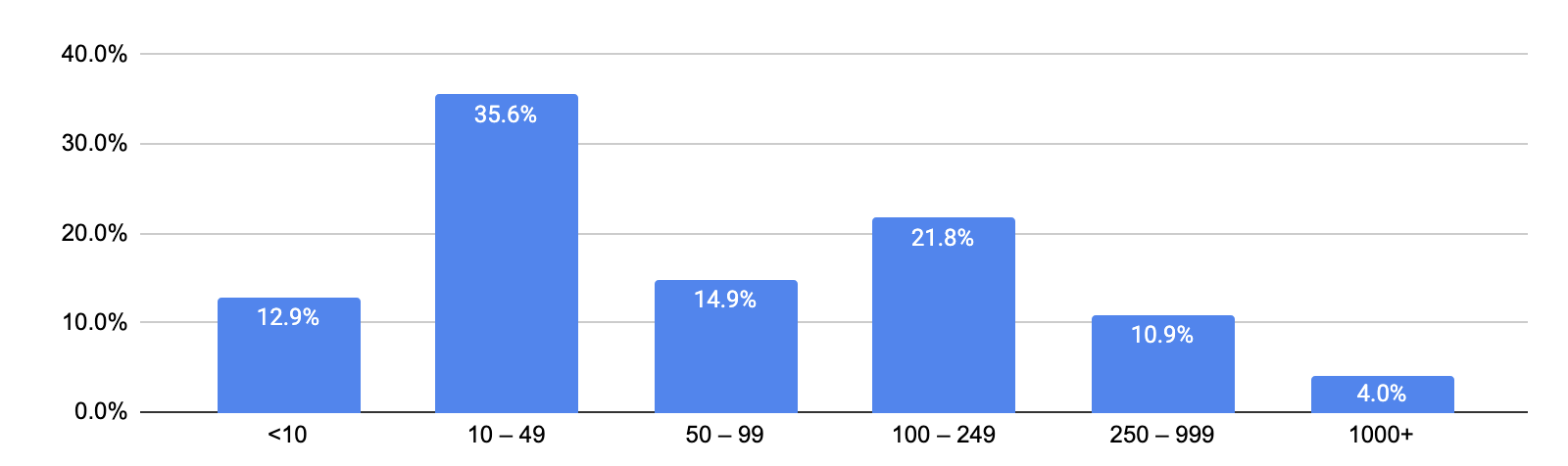
Participants came from 23 countries across North America, Europe, South Asia, Southeast Asia, and other global regions. The majority of respondents (63.4%) represented companies with under 100 employees, reflecting the broader global SME landscape. Companies with 100–249 employees made up 21.8% of respondents, while larger enterprises (250+ employees) accounted for the remaining 14.9%.
Where applicable, 2026 findings are compared against Techreviewer's previous surveys from 2025 and 2023 to identify multi-year trends. Percentage figures throughout the report reflect the share of respondents who selected each answer option. Some questions allowed multiple selections, so totals may exceed 100%.
Overview of IT Services Companies
A total of 101 companies participated in Techreviewer’s April 2026 survey. Each gave a broad view of how providers are managing marketing, customer acquisition, and market competition in 2026. Respondents came from 23 countries across North America, Europe, South Asia, Southeast Asia, and other global regions.
Company Size
- Companies with fewer than 100 employees accounted for the majority (63.4%) of respondents in this survey. All are small- to mid-sized IT services providers.
- 21.8% of respondents had 100-249 employees. A company this size is typically growing rapidly and is actively expanding its client base.
- As usual, large companies represent the smallest cohort in this survey, with 10.9% having 250-999 employees and 4% having over 1,000.
Overall, small- to mid-sized companies made up the majority of the responses gathered in this survey. This aligns with the broader global business landscape, where the World Bank has reported that SMEs make up approximately 90% of businesses worldwide.
Company Location
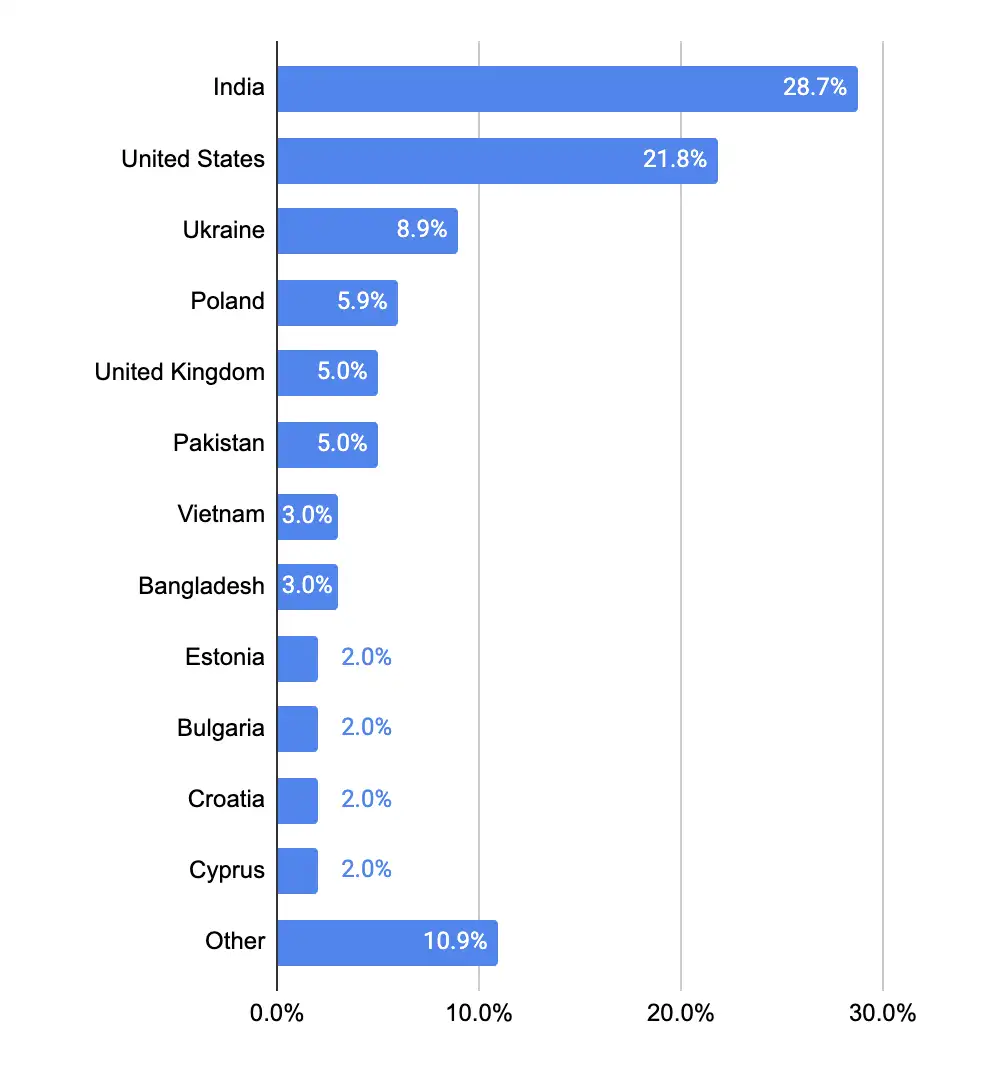
India led the way in company location, with 28.7%, giving Asia the strongest representation of IT services companies. Other respondents in Asia included Pakistan, Vietnam, Bangladesh, and Cyprus, with Malaysia and Armenia listed inside Other. South and Southeast Asia are major hubs for IT outsourcing and software development.
Not surprisingly, North America was also strongly represented, with 21.8% of respondents located in the United States. This market has a high demand for IT services and outsourced technology support.
Companies from Ukraine (8.9%) and Poland (5.9%) had fair representation in this survey, as did the UK (5%). A high degree of technical talent and nearshore development in Europe could be factoring into these numbers.
Target Location
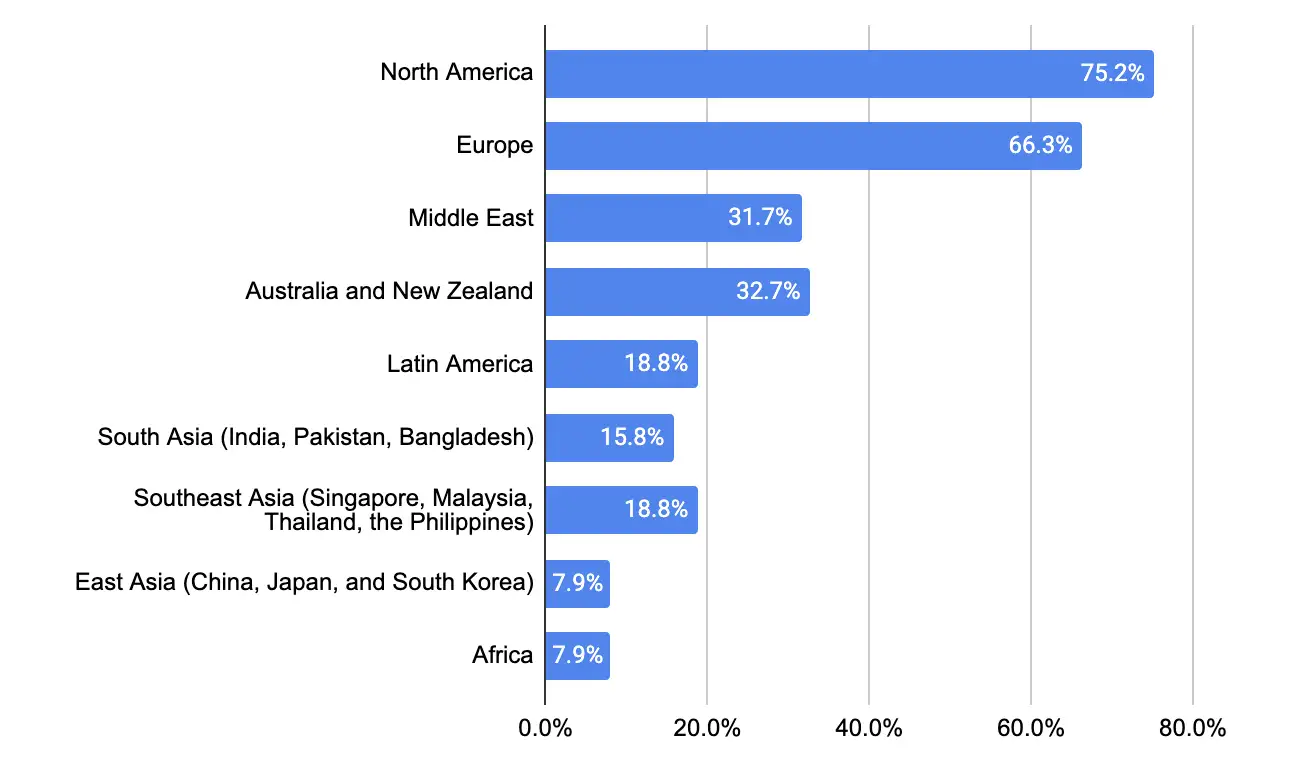
- North America is a priority region for IT services marketing, as 75.2% of respondents noted.
- Not far behind North America is Europe at 66.3%. Continuing demand from high-value IT services markets likely puts this region in second position.
- Australia and New Zealand followed, with 32.7% of respondents indicating they’re targeting these regions.
- The Middle East was close behind at 31.7%, suggesting continued interest in markets with active digital transformation initiatives.
- Tied at 18.8% are Latin America and Southeast Asia. This points to some interest in emerging and nearshore markets.
Africa and East Asia had the lowest target interest, with 7.9% of respondents interested in marketing services to each of these locations. Language barriers and lack of market access could be reasons for such low interest.
Key Takeaways:
The data here shows a major focus on North America and Europe, showing that most IT services companies are concentrating their marketing efforts in mature, high-value regions where demand, budgets, and outsourcing adoption are established.
Competition is highly competitive for these markets, and with so many providers targeting the same regions, any kind of generic messaging is less likely to stand out. Providing clearer differentiation, stronger proof points, and specific positioning around the value proposition will be important to companies marketing to businesses in these locations.
Comparison of Main Target Regions
.webp)
After multiple years of gathering statistics about IT services marketing, Techreviewer has a number of valuable comparisons from its respondents about marketing strategies for IT companies.
This first year-over-year main target region comparison between 2025 and 2026 reveals that marketing for IT companies still involves prioritizing mature markets. However, in 2026, there was a definitive push for diversification.
- Still a top target region, North America slipped slightly in focus from 77.4% in 2025 to 75.2% in 2026.
- Europe was one of the stronger movers among major markets, jumping 59.7% to 66.3% in a year and narrowing the gap with North America.
- Two more groups with sizable moves upward include Australia & New Zealand, rising from 25.8% to 32.7% and the Middle East, from 27.4% to 31.7%.
- The sharpest jump of all regions was in Southeast Asia. This area rose 7.5% from 11.3% in 2025 to 18.8% in 2026.
- South Asia also declined, and targeting fell from 17.7% to 15.8% from 2025 to 2026.
Key Takeaways:
North America and Europe still offer strong demand, established buyer pools, and mature outsourcing relationships, so there’s no major shift away from these regions. A key consideration here is that expanding into Australia and New Zealand, the Middle East, and Southeast Asia may help companies reduce dependence on the two core regions and increase presence in markets undergoing digital transformation.
For providers, diversification into these regions can support growth while reducing exposure to saturation, pricing pressure, and slower demand in any single market.
Types of Customers
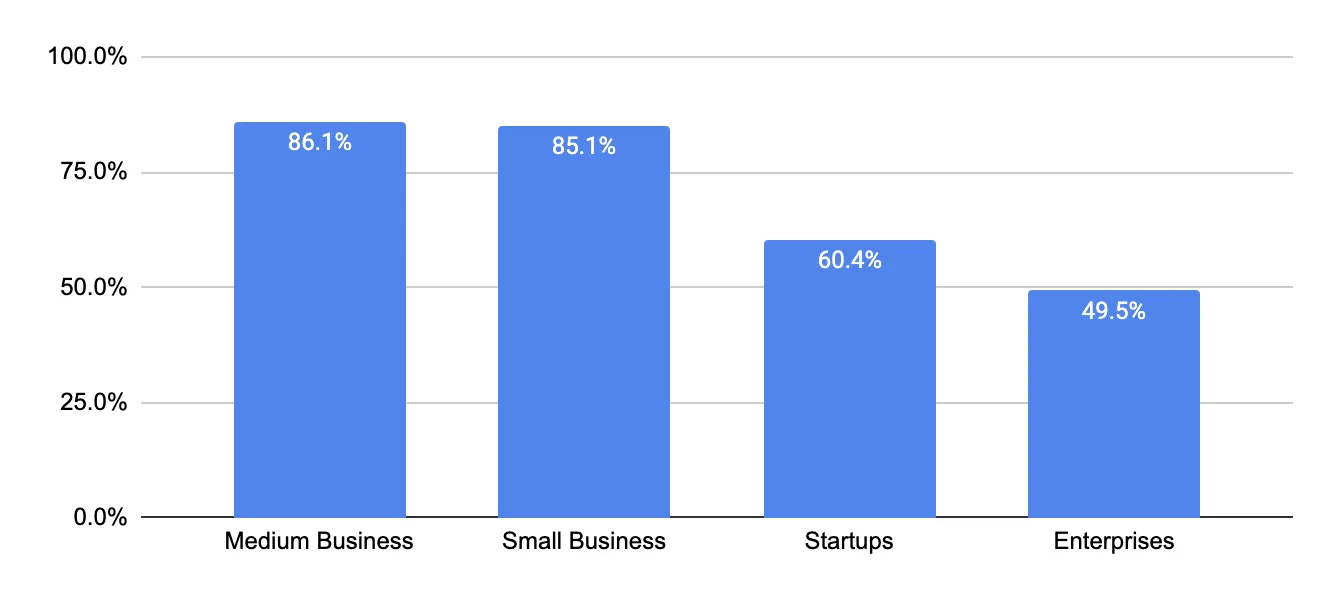
IT services companies continue to attract the strongest interest from small and medium- sized businesses, but startups and enterprises continue to be important parts of the overall customer base.
- The strongest customer segment is medium-sized businesses. 86.1% of respondents are gaining this type of customer base.
- Small businesses are almost parallel to the medium-sized segment, and 85.1% of those surveyed are reaching this size of team.
- 60.4% of respondents are attracting startups through their marketing efforts, and 49.5% are gaining business from enterprises — the least common customer type, but significant in the overall market.
Key Takeaways:
This customer distribution mirrors the respondent pool itself and aligns with the broader global business landscape, where SMEs make up about 90% of businesses worldwide according to the World Bank.
This SME-heavy customer mix has direct implications for positioning, and providers might need to show how their services help leaner teams solve more technical problems, control costs, and scale — without increasing operational burden. Practicality, flexibility and measurable business outcomes will show real value.
Comparison of Customer Types
.webp)
After measuring IT services companies for three years, Techreviewer found that medium-sized businesses remain the leading customer segment, reaching 86.1% in 2026 after peaking in 2025 at 88.7%. Compared with 2023, this segment increased by 4.3 percentage points.
- The strongest increase in 2026 came from small businesses. With a 7.7 percentage-point rise from 2025 to 2026, this customer type reached 85.1% in 2026, just a percent under medium-sized businesses.
- Making a rebound from a drop in 2025, startups increased from 53.2% to 60.4%. Still, they are significantly below their 78.8% level in 2023.
- Enterprise customers are a gradually growing customer type, moving from 42.4% in 2023 to 49.5% in 2026.
- IT services providers continually attract the most interest from small and medium-sized businesses, but the customer mix is becoming broader.
Being a sizable market, worldwide IT spending is projected to reach $6.31 trillion in 2026 — up 13.5% from 2025. Comparatively, global AI spending looks to grow 47% year over year, according to Gartner.
Key Takeaways:
The broader mix of customers here suggests that IT service providers need more segmented marketing and pricing strategies. SMBs will likely be seeking practical value, flexibility, and cost control, while startups will search for speed, scalability, and technical guidance. As far as enterprise buyers, they’re more likely to expect proof of expertise, risk reduction, and support for their ongoing IT needs.
Price Range
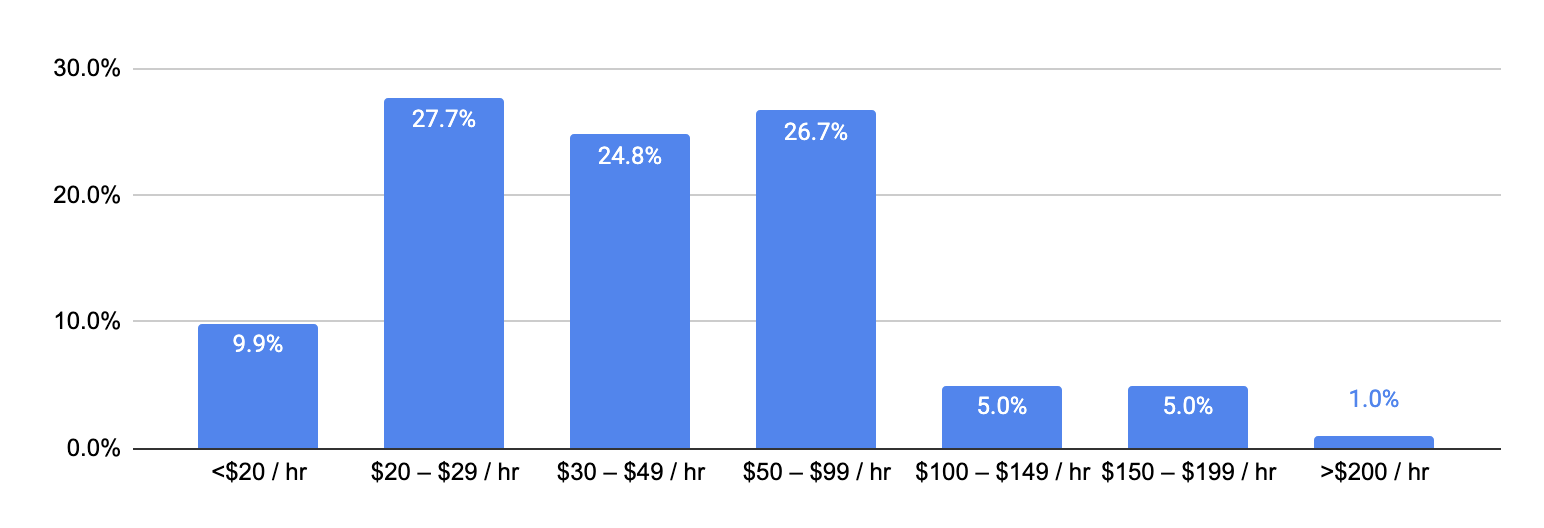
- Less than $20/hour (9.9%). It’s typical to find lower-cost providers in regions with lower operating costs. Appealing to startups and small businesses, these providers can deliver good value without stretching a budget.
- $20–$29/hour (27.7%) Affordable and highly skilled, the service providers in this price tier are the largest pricing group surveyed.
- $30–$49/hour (24.8%). Considered lower-mid range in pricing, this strongly positioned group can appeal to those looking for strong expertise while still staying within a budget.
- $50–$99/hour: 26.7% This upper-mid range group holds a major pricing tier. Quality, experience, and specialization capabilities justify this price range.
- $100–$149/hour (5.0%). For businesses seeking advanced consulting services and targeted strategy, IT service companies in this range are considered premium.
- $150–$199/hour (5.0%) Another premium segment, companies in this group will offer advanced consulting and serve highly specialized industries.
- More than $200/hour (1.0%). Elite companies operate at this level and will typically offer highly technical assistance to specialized clients.
Key Takeaways:
With pricing concentration sitting in the $20-$99/hour range, the competition for this group is strongest in small- to medium-sized markets. Higher hourly ranges aren’t nearly as common, and this is likely because many providers want accessibility, practical skills, and service that won’t break a budget.
IT services companies in the crowded mid-range should show why their expertise, delivery quality, or specialization makes them a stronger choice than lower-cost competitors. More premium providers may need to show stronger proof points, case studies, and niche expertise in order to claim higher hourly rates.
Comparison of Price Ranges
.webp)
With many respondents citing concerns about economic recession, the shift toward IT services companies in the $20-29/hr range is in alignment with potential budget changes.
With many respondents citing concerns about economic recession, the shift toward IT services companies in the $20–$29/hour range aligns with potential budget pressure.
- The $20–$29/hour range rose from 15.4% in 2023 to 27.7% in 2026 and has become the largest pricing category of all. The competition for affordable providers is heating up.
- Use of providers in the $30–$49/hour range dropped sharply, falling from 42.3% in 2023 to 24.8% in 2026. Although it was the dominant tier in 2023, value-seeking businesses may be shifting toward lower-cost options as budget pressure increases.
- Softening some, the $50–$99/hour range is still an important tier, likely due to being more specialized and technical. This tier declined from 30.8% in 2023 to 26.7% in 2026.
- 11% of respondents are now charging $100/hr and higher. In contrast, no survey respondents had rates above $100/hr in 2023. Inflation may play a role in price hikes here, but this could also mean that providers in this range are performing higher-level consulting, AI-related services, and specialized technical support.
Key Takeaways:
In 2026, hourly pricing is segmenting. The $20-$29/hr market is booming, suggesting competition for services in this space is growing rapidly as companies respond to economic pressure. At the same time, the small rise in $100+/hour providers points to a separate premium tier built around AI-related services and specialized technical support.
Types of Services
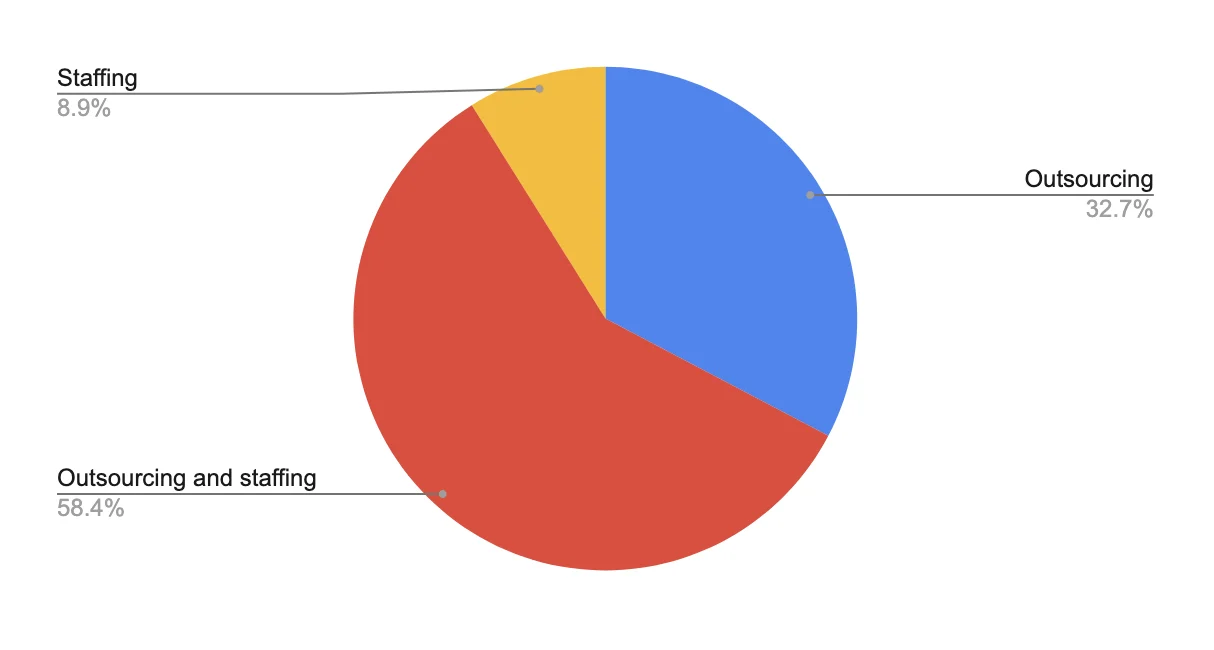
Outsourcing and staffing (58.4%)
Because today’s clients need flexibility as AI actively changes operating environments, marketing strategy for IT companies will often include outsourcing and staffing. An IT service provider may manage an entire project or place a skilled professional with a client’s existing team. Offering these options allows for multiple delivery model offerings. Plus, a wider range of client needs can be met.
Outsourcing only (32.7%)
Nearly one-third of respondents only focus on outsourcing, and these providers likely position themselves as full-service project providers. What this means is that a client can hand off an entire segment of work and not have to touch it at all.
Staffing only (8.9%)
Staffing-only providers are the smallest segment of respondents in this survey. From the numbers, it can be assumed that standalone staffing is far less common than other service models. Access to employee talent is important, but so is specialized expertise, managerial support, and contractual flexibility.
Key Takeaways:
The flexibility of a dual service model is the clear winner in marketing for software companies. As AI technology changes work roles and capabilities in the coming years, companies offering outsourcing and staffing could continue holding the competitive edge.
Marketing Channels
Primary Marketing Channels
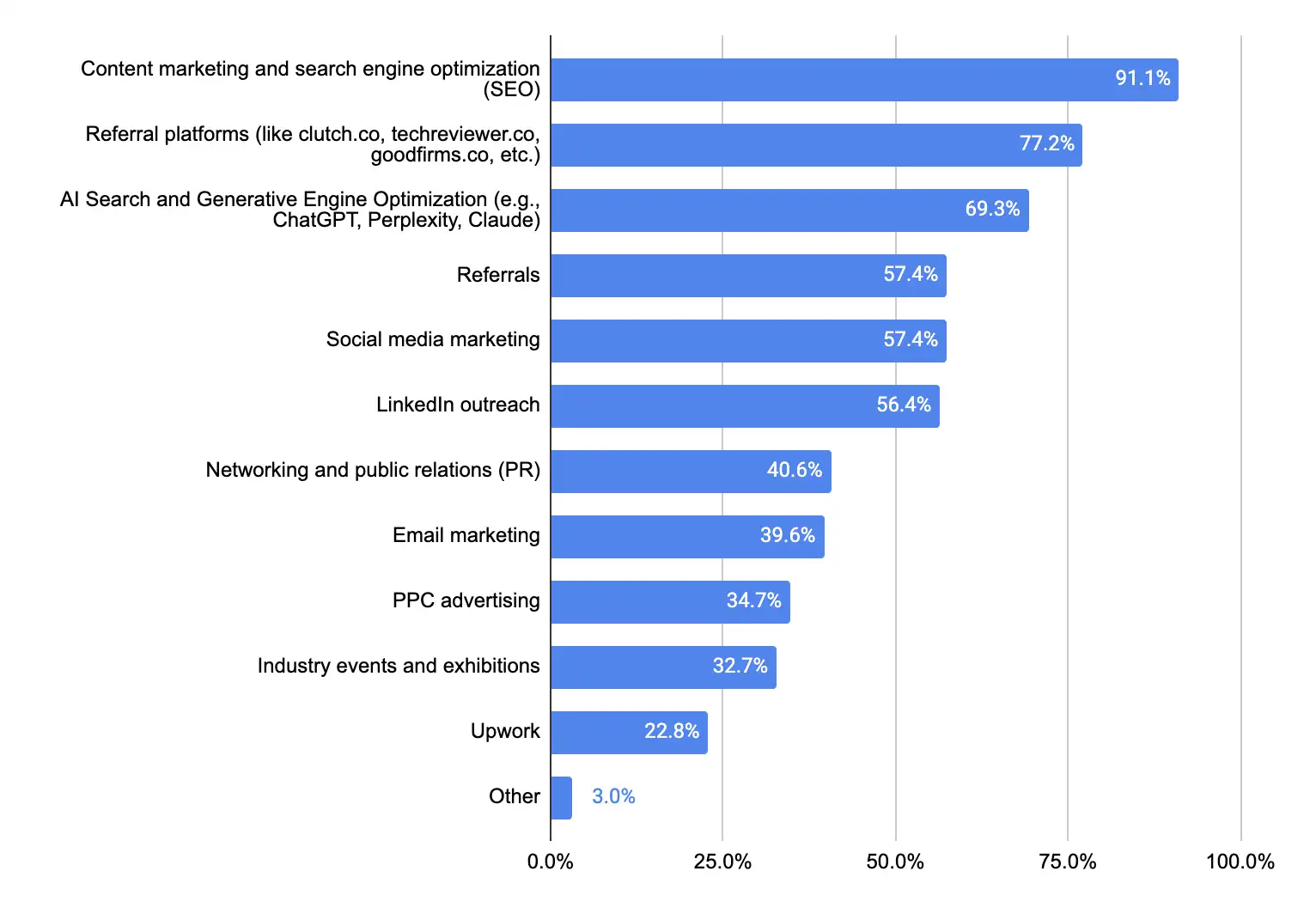
In this survey, respondents reported a wide range of primary channels in digital marketing for IT companies and customer acquisition in 2026. Some percentages may be surprising, but could serve as indicators of how widely AI technology is disrupting IT services marketing and B2B marketing for software companies.
Content marketing and SEO (91.1%)
The leader in marketing strategy for IT companies is content marketing and SEO. Industry buyers tend to research providers at length before contacting them and agreeing to a sales call. With Gartner finding that 67% of B2B buyers prefer a rep-free experience and 45% using AI while making purchases, high-performing content and SEO serve their purpose well.
Referral platforms (77.2%)
Referral platforms are the second most-used channel in marketing for software companies, and platforms like Clutch and Techreviewer can give buyers a way to compare vendors on their own time.
AI Search and Generative Engine Optimization (69.3%)
Coming in third for IT services marketing is AI search and generative engine optimization. This rank makes optimizing content for AI-assisted buyer research a necessity, so content development will increasingly need to shift in this direction.
Referrals (57.4%)
Trust is a pillar in IT services, and referrals hold a lot of weight when businesses are prospecting providers. Anything that can reduce perceived risk is beneficial, from testimonials and business contact referrals to recommendations from existing clients.
Social media marketing (57.4%)
57.4% of respondents use social media marketing to reach their audiences. While it’s not a top lead generation tool, it can help support ongoing brand presence.
LinkedIn outreach (56.4%)
A social media channel all its own, LinkedIn is a popular thought leadership channel and gives potential clients direct access to founders, CEOs, executive leaders, and technical experts. Growing a personal brand under the company umbrella has been a strategy for many thought leaders across industries in recent years.
We plan to invest more in personal branding (LinkedIn) to build trust and generate inbound leads, as well as expand our content marketing through thought leadership posts, case studies, and educational content. We’re also exploring short-form video content to increase reach and engagement, and testing AI-driven outreach to make our lead generation more personalized and efficient. Overall, our goal is to balance experimentation with proven channels, focusing on what brings measurable business impact. – Mid-sized IT Services Company (100–250 employees), Ukraine
Networking and PR (40.6%)
Networking and public relations are still a big part of marketing for IT companies, but the percentage of spend on these activities is in decline. The traditional nature of these tactics may explain why more modern marketing strategies have taken hold.
Email marketing (39.6%)
Once considered a low-cost, high-converting marketing activity, email marketing in IT services is falling behind as an acquisition strategy. With inboxes becoming increasingly crowded, even a top-notch subject line might not provoke a potential client to click through.
PPC advertising (34.7%)
PPC advertising is used in moderation among those responding to this survey. Paid search is easy to create visibility, but conversion can be more difficult.
Industry events and exhibitions (32.7%)
Face-to-face engagement is helpful for building credibility, but the low ranking indicated by survey respondents could indicate lower conversion rates. To that end, Cvent reported that 94% of marketers think their company fails to convert event leads into opportunities.
Upwork (22.8%)
Upwork is the lowest-used named channel reported by survey respondents. It’s traditionally been a good platform for freelance or project-based work, but whether those relationships become long-term partnerships or hires isn’t clear.
Key Takeaways:
Marketing channels supporting self-directed buyer research are leading IT services customer acquisition in 2026, and these include content marketing, SEO, referral platforms, AI search, and referrals. They all help buyers research and compare providers before making direct contact.
Comparison of Primary Channels
.webp)
Primary channels in marketing strategy for IT services companies have been shifting. And the biggest pattern? IT services companies are relying more and more on self-directed search visibility. Traditional channels popularized decades ago, on the other hand, are losing traction.
Content marketing and SEO are strong
Content marketing and SEO increased to 88.7% in 2025 from 84.8% just two years before. In 2026, that number grew to 91.1%. That brings the 2026 figure up from 84.8% in 2023 to 91.1%.
AI search entered as a major channel
AI Search and Generative Engine Optimization weren’t in the 2023 or 2025 surveys, but it’s worth reiterating the ranking of 69.3% in 2026. If companies aren’t optimizing for AI-assisted buyer research, now is the time to start.
Referral platforms climbed nicely in 2026
84.8% of respondents reported referral platforms as a primary channel in 2023, but that percentage dropped in 2025 to 71%. This year, the number rose again to 77.2%, making referral platforms one of the strongest customer acquisition channels for those surveyed.
In general, until we have a better understanding of how to show up in LLMs and stay ahead of rapid content generation from AI, we are at the mercy of the LLMs. Referral companies as you suggest, do not necessarily give referrals and are more of a required signal for LLMs to better understand the business. For example, we only have a profile on Techreviewer because it sometimes gets picked up by LLMs but only sometimes. Before LLMs we just had it because some information on there was incorrect. – Small-sized IT Services Company (10–49 employees), United States
Email marketing has declined every year
With incremental drops across all three years, email marketing is showing the clearest downward trend of all channels in the survey.
Industry events and exhibitions also continue to decline in use
Events and exhibitions went from 39.4% in 2023 to 37.1% in 2025 to 32.7% in 2026. They still hold value for networking and credibility, but they’re being used less often as self-directed searches become stronger lead-generation tools.
LinkedIn outreach is dropping, but it’s still important
LinkedIn outreach was not included in the 2023 data, but it was at 61.3% in 2025 and declined slightly this year to 56.4%. Despite the decline, it’s a strong relationship-based channel with a high executive and decision-maker presence.
Social media and referrals nudged upward in 2026
Both referrals and social media marketing were 63.6% in 2023, but they dropped to 54.8% in 2025 before rising back up this year to 57.4%. They’re still relevant, but neither has returned to its 2023 level.
Key Takeaway:
The three-year pattern here suggests that CMOs should consider reallocating budget toward channels that support buyer-led research, including content marketing, SEO, referral platforms, and AI search. All of these channels help prospects discover, compare, and validate providers before speaking with sales.
Focus on where attention is going, not where it’s been: AI-driven discovery and individual credibility are compounding fast, so we’re investing in being the source models cite and building real distribution through people, not logos. At the same time, we’re owning the relationship because the best companies won’t rent their audience anymore. – Mid-sized IT Services Company (50–99 employees), United States
CMOs should also review email marketing and industry events more closely before allocating more budget toward them. Both of these channels have declined across the survey period, and this suggests they may need tighter targeting or smaller roles in the overall acquisition strategy.
To begin improving primary channels in the next quarter, IT services companies should:
- Audit content for AI search visibility.
- Strengthen referral platform profiles with stronger proof points.
- Shift the budget away from broad, low-converting outreach toward channels that make provider expertise easier to find and verify.
The Most Effective Marketing Channels
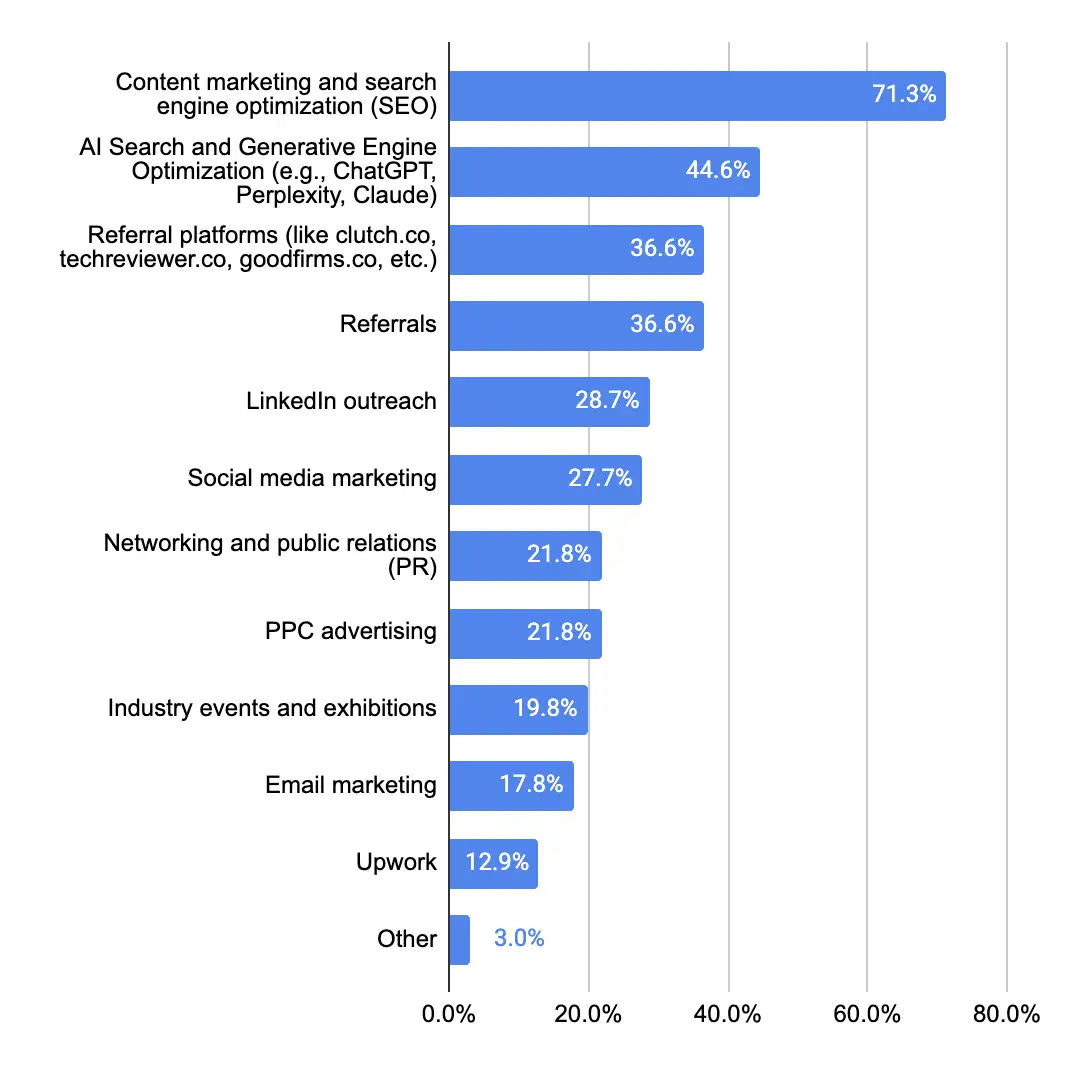
Techreviewer asked respondents which marketing channels were most effective for them in the past year. As expected, the results showed that content marketing and SEO sat at the top.
- Content marketing and SEO (71.3%): As the strongest channel, content marketing and SEO clearly reveal the value of search visibility when it comes to attracting IT services buyers.
- AI Search and Generative Engine Optimization (44.6%): AI-assisted search is quickly becoming an important part of the buyer discovery process in evaluating IT services providers. It came in second.
- Referral platforms (36.6%): Tied for third, this channel helps build credibility through reviews, testimonials, and rankings.
- Referrals (36.6%): Tied with referral platforms, referrals play a significant role in IT service buying decisions.
- LinkedIn outreach (28.7%): In fifth place, LinkedIn is good at reaching decision-makers and building professional visibility.
- Social media marketing (27.7%): In the middle of the rankings, social media ranked lower in effectiveness but is still relevant in brand awareness and ongoing engagement.
- Networking and PR (21.8%): These traditional marketing methods ranked seventh in 2026 and showed lower reported effectiveness than the leading search- and referral-based channels.
- PPC advertising (21.8%): Lagging well behind, paid campaigns can generate visibility but might be harder to convert into leads.
- Industry events and exhibitions (19.8%): Attending these requires a lot of effort, and respondents aren’t finding them very helpful in customer acquisition.
- Email marketing (17.8%): In tenth place, email marketing is at risk as inboxes are continually overwhelmed with messages.
- Upwork (12.9%): This channel ranked near the bottom for reported effectiveness.
- Other (3.0%): A small share of respondents identified other channels as their most effective source of customer acquisition.
Expanding investment in AI-driven discovery (Generative Engine Optimization across platforms like ChatGPT and Perplexity), strengthening thought leadership through high-value QA and AI testing content, and leveraging strategic partnerships with industry platforms and events. We are also focusing on account-based marketing (ABM) and intent-driven LinkedIn outreach to target enterprise decision-makers more effectively. – Mid-sized IT Services Company (100–250 employees), India
Key Takeaways:
If marketing channel effectiveness keeps shifting toward search and AI-assisted discovery, the pipeline strategy will need to start earlier in the buyer journey. That means IT service providers will need stronger content, SEO, and GEO skills inside their marketing teams, along with a tech stack that can track how buyers find, compare, and validate providers before they ever speak to sales.
Comparison of the Most Effective Marketing Channels
.webp)
Respondents were asked what the most effective marketing channels were for them, across three years. This chart focuses on what companies say is actually producing results.
- Content marketing and SEO became the most effective channel, rising from 36.4% in 2023 to 69.4% in 2025 and 71.3% in 2026.
- AI Search and Generative Engine Optimization appeared for the first time in 2026 as the second-most effective channel, reaching 44.6%.
- Referrals declined, falling from 51.5% in 2023 to 45.2% in 2025 and 36.6% in 2026. They’re still important, but they don’t hold the same weight today.
- Referral platforms are a medium-performing channel, moving from 30.3% in 2023 to 40.3% in 2025 and then 36.6% in 2026.
- LinkedIn outreach is still higher than it was in 2023, but it declined to 28.7% in 2026 from 35.5% in 2025.
- Email marketing dropped sharply this year, falling from 29.0% in 2025 to 17.8% in 2026, slightly below its 2023 level of 18.2%.
Key Takeaways:
Effectiveness data here shows focus is shifting toward channels that help buyers find and evaluate providers before direct contact. Content marketing and SEO are now far ahead of every other channel, and AI search has quickly become a major part of the visibility strategy.
To take advantage of leading marketing channels, IT services providers should prioritize channels that support buyer research before direct contact. Referrals and referral platforms still hold relevance, but declining effectiveness means it will be important to strengthen proof points and positioning while formulating a marketing strategy.
Marketing Channels That Didn’t Meet Expectations
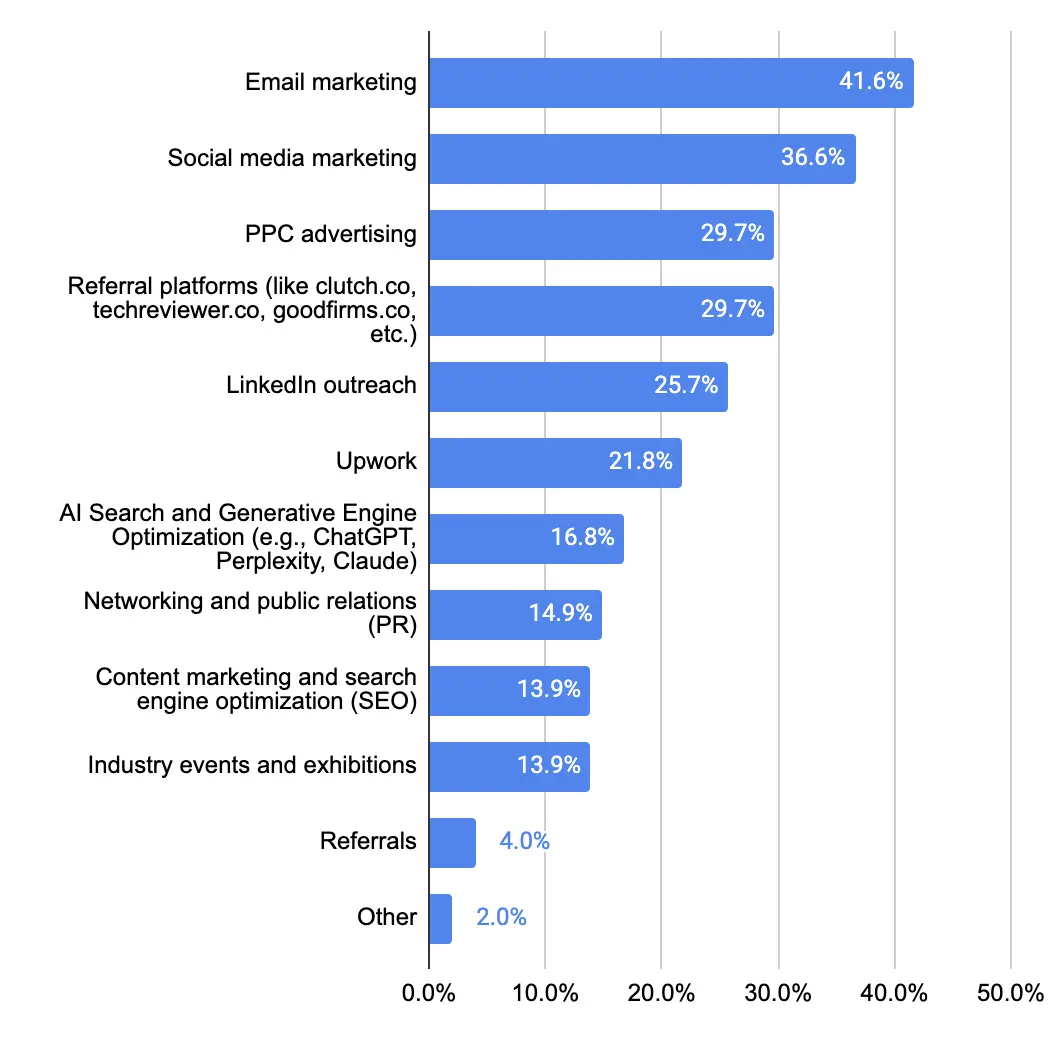
Respondents reported a varying level of disappointment about marketing channels in 2026, with email marketing being the top disappointment. Here are the results:
- Email Marketing (41.6%): A high underperformer, email marketing may be losing impact as inboxes become more crowded, despite its ease of execution and low cost.
- Social Media Marketing (36.6%): The second-highest disappointment in the lineup, social media marketing may still support visibility, but many companies struggle with turning attention into qualified leads.
- PPC Advertising (29.7%): Expensive and highly competitive, PPC advertising may be harder to justify when traffic doesn’t convert into strong sales opportunities.
- Referral Platforms (29.7%): Also an underperformer for some respondents, referral platforms might depend heavily on profile strength, customer reviews, rankings, category competition, and how clearly a provider differentiates itself from similar companies.
- LinkedIn Outreach (25.7%): There’s some level of disappointment here, but well-positioned content can reach the right audience on this platform.
- Upwork (21.8%): This platform is popular for freelance and project work, but hasn’t gotten IT services companies as many opportunities for solid, long-term engagement.
- AI Search and Generative Engine Optimization (16.8%): Less disappointing than expected, this channel is showing promise as a key driver in marketing.
- Networking and PR (14.9%): Results here were better than expected, reinforcing that targeted relationship building can be very effective.
- Content Marketing and SEO (13.9%): As the top marketing channel in 2026, this channel had relatively low disappointment, making it highly dependable in the coming quarters.
- Industry Events and Exhibitions (13.9%): Also low in disappointment, targeted events and shows may still bring good value to an IT services company.
- Referrals (4.0%): The least disappointing of all channels, good referrals are still an important source of customer acquisition.
Key Takeaways:
The most disappointing channels in 2026 were email marketing, social media, PPC advertising, and referral platforms. While companies shouldn’t cut them automatically, they should review performance carefully and optimize targeting and messaging before committing more budget.
Companies should also consider repositioning channels that support awareness rather than direct acquisition and reduce investment where the return is consistently weak.
Comparison of Marketing Channels That Didn’t Meet Expectations
.webp)
This chart reveals how dissatisfaction with marketing channels has changed across the 2023, 2025, and 2026 surveys.
- Content marketing and SEO: As one of the best channels, disappointment here was at its lowest level in 2026 at 13.9%.
- Email marketing: Emails proved to be highly disappointing, reaching the highest level yet in 2026 at 41.6%.
- Industry events and exhibitions: Dissatisfaction dropped from 22.6% in 2025 to 13.9% in 2026, so this suggests that targeted events may still provide value.
- LinkedIn outreach: Disappointment increased from 19.4% in 2025 to 25.7% in 2026, so strongly positioned messaging is likely crucial for success here.
- Networking and PR: With seesawing results across the years, networking and PR haven’t been consistent performers in marketing.
- PPC advertising: Expensive and competitive, dissatisfaction with this channel rose to 29.7%.
- Referral platforms: A consistent underperformer all three years, correct positioning on each platform will provide, at a minimum, the information a potential client needs to help make a decision.
- Referrals: Referrals have been the least disappointing in 2026. Only 4.0% of respondents reported unmet expectations.
- Social media marketing: Dissatisfaction with social media increased by 21.4% from 2023 to 2026, possibly indicating less interest here by decision makers looking for IT services.
- Upwork: A mixed channel overall, disappointment declined slightly from 24.2% in 2025 to 21.8% in 2026.
- AI Search and Generative Engine Optimization: Brand new in 2026, AI search has a low disappointment rate compared to older, more traditional channels.
Key Takeaways:
This comparison is showing growing frustration with channels that are crowded, expensive, or difficult to convert. IT service providers don’t necessarily need to abandon these channels, but they should evaluate whether each one needs better targeting, stronger positioning, or less budget allocation.
In contrast, referrals, content marketing, SEO, industry events, and AI search were less disappointing in 2026, and this suggests that trust-based channels and buyer-research-driven visibility could be more reliable.
Primary Channels vs. Disappointing Channels
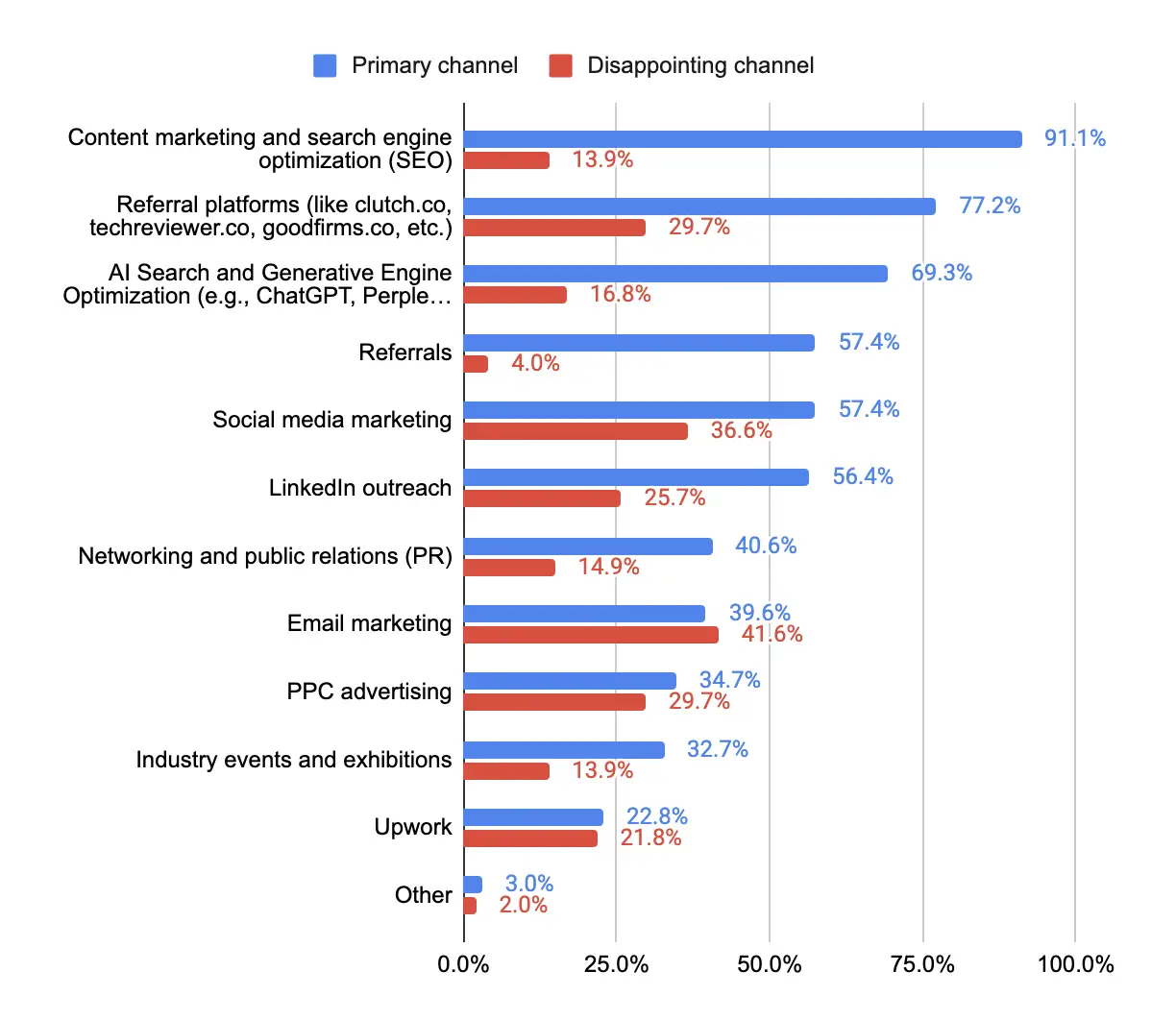
This chart compares primary marketing channel usage with channels respondents said didn’t live up to expectations.
- Content marketing and SEO: With 91.1% usage and only 13.9% disappointment, this channel is the top performer overall.
- Referral platforms: Referral platforms continue to be important for visibility, but since 29.7% of respondents are dissatisfied with performance, positioning is critical in these marketing spaces.
- AI Search and Generative Engine Optimization: With 69.3% usage in 2026 and a relatively low disappointment rate of 16.8%, there’s good value appearing in this category, with few problems.
- Referrals: Referrals stand out as a highly reliable channel, with only 4.0% saying they have not met expectations.
- Social media marketing: Social media is showing a weaker relationship between adoption and satisfaction, with 57.4% usage and 36.6% disappointment.
- LinkedIn outreach: Respondents reported 56.4% usage of this channel, with 25.7% saying the platform didn’t meet expectations.
- Email marketing: The level of disappointment with email marketing slightly exceeded its usage, showing clear underperformance.
- PPC advertising: PPC was very similar to email marketing as far as results. Respondents reported 34.7% usage and 29.7% disappointment.
- Industry events and exhibitions: Events have 32.7% usage and only 13.9% disappointment. Targeted shows will likely remain a good strategy in the coming years, however.
- Upwork: This channel was similar to email marketing and PPC advertising, with 22.8% usage and 21.8% disappointment. The numbers suggest limited payoff for survey respondents.
Key Takeaways:
The strongest opportunities are in channels that are widely used but generate relatively little disappointment, and that includes content marketing, SEO, AI search, and referrals. All of these help buyers find, compare, and vet providers before setting aside time to speak to a sales team.
Before allocating more budget toward higher disappointment channels like email, social media, PPC, Upwork, and referral platforms, take a closer look at each and analyze for ROI. Doing so will help distinguish between reliable pipeline drivers and weaker channels.
Marketing Budget Allocation by Channel
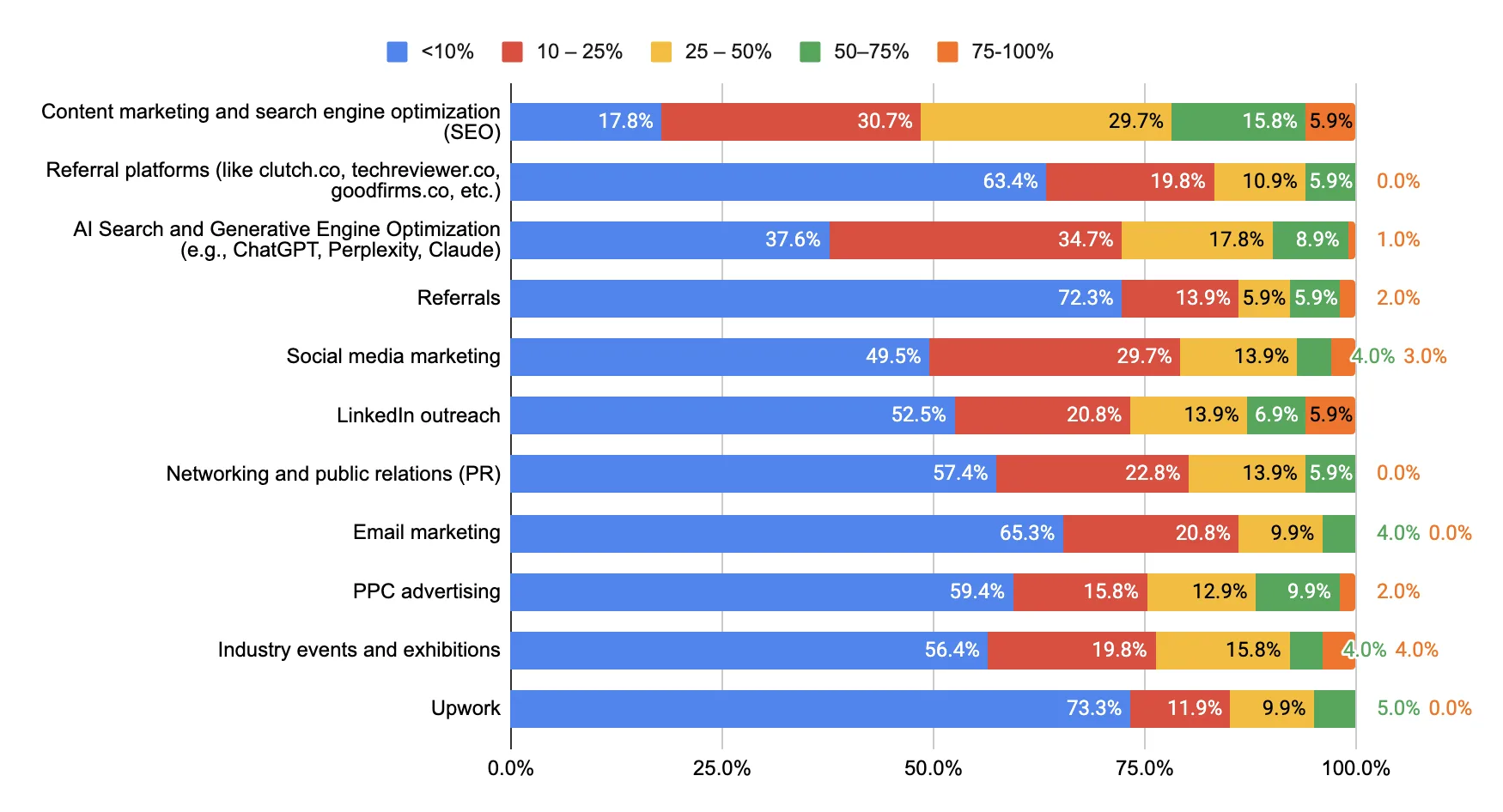
Techreviewer asked respondents what percentage of their marketing budget they allocate to each channel. To help identify where larger budget commitments are going, the percentages below show weighted averages calculated from bracket midpoints.
- Content marketing and SEO: 32.4%
- AI Search and Generative Engine Optimization: 21.1%
- LinkedIn outreach: 21%
- PPC advertising: 18.5%
- Industry events and exhibitions: 18.2%
- Social media marketing: 18%
- Networking and PR: 15.8%
- Referral platforms: 14.4%
- Referrals: 13.7%
- Email marketing: 13.1%
- Upwork: 12.6%
Key Takeaways:
- Content marketing & SEO is the dominant channel – it commands the highest budget allocation by a wide margin, with over half of respondents investing 25% or more of their marketing budget in it. No other channel comes close.
- Most channels are treated as secondary investments – for 10 out of 11 channels, the majority of respondents (often 50–70%+) spend less than 10% of their budget, indicating a clear hub-and-spoke model where SEO is the core and everything else is supplementary.
- AI Search & Generative Engine is the rising challenger – despite being a newer channel, it already rivals LinkedIn outreach in average budget share (~21%), signaling that IT services companies are beginning to invest meaningfully in AI-driven visibility.
- Referral platforms are chronically underfunded – 63.4% of respondents allocate less than 10% of their budget to platforms like Clutch, Techreviewer, or GoodFirms, despite the proven role of third-party reviews in B2B buying decisions.
- PPC has a committed power-user segment – while most companies underinvest in paid advertising, a notable 9.9% allocate 50–75% of their budget to PPC, the highest concentration in that bracket outside of SEO, pointing to a performance-marketing-first minority.
- Upwork and email marketing are the most neglected channels – both sit at the bottom of average budget share (~12–13%), with zero respondents going above 75% on either, suggesting they are used tactically rather than strategically.
Factors Influencing Purchase Decisions of IT Service Buyers
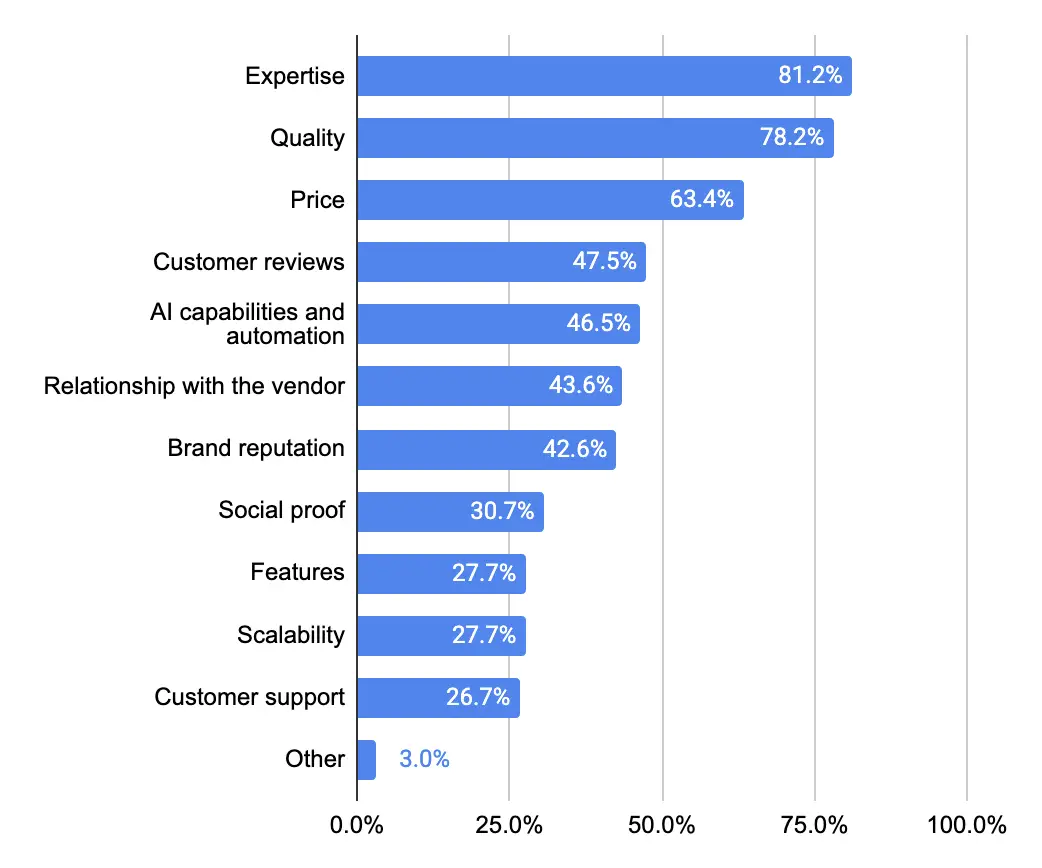
Expertise (81.2%), quality (78.2%), and price (63.4%) in potential IT services providers were very important to potential clients, while features, scalability, and support made little difference in decision-making.
Key Takeaways:
IT service buyers aren’t looking for generalized claims about experience or quality, so companies need to prove those with specific marketing and sales assets like case studies, technical certifications, client reviews, and project outcomes. To position well, show how expertise and quality reduce risk, improve execution, and produce better business outcomes.
Comparison of Factors Influencing Purchase Decisions of IT Service Buyers
.webp)
In 2025 and 2026, expertise was the most important factor influencing purchase decisions, reaching 85.5% in 2025 and 81.2% in 2026. The biggest shift was in pricing, which declined as a decision factor from 87.9% in 2023 to 63.4% in 2026.
Customer reviews made a big rebound from 27.4% in 2025 to 47.5% in 2026. Also entering the rankings in 2026 was AI at 46.5%.
Key Takeaways:
Data points gathered in this comparison point to a more proof-driven buying process. Expertise still matters the most, but buyers are also putting more weight on visible credibility, AI capability, and evidence of outcomes.
To stay competitive, IT services companies should invest in stronger case studies, clearer AI narratives, client proof points, and customer feedback that can show how their expertise translates easily into measurable business value.
Competitive Landscape in the IT Services Market
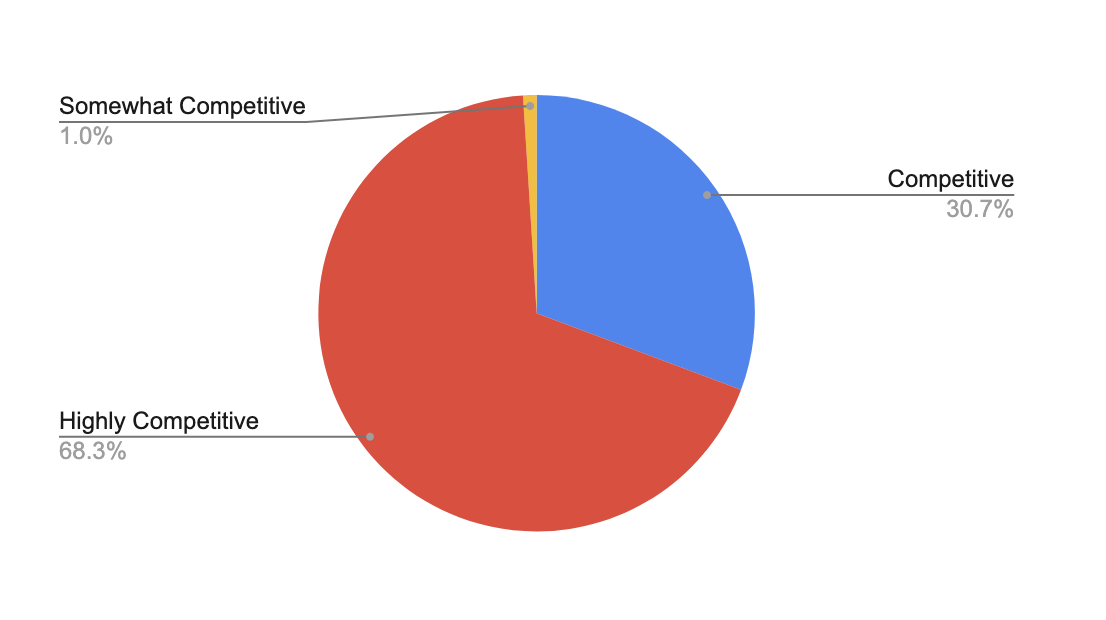
Over 68% respondents said the 2026 IT services market was highly competitive, while 30.7% called it competitive. Only 1% said it was somewhat competitive.
Key Takeaways:
The market is crowded, so having clear positioning, credible proof, and visible differentiation is even more important for agencies trying to stand out.
Comparison of the Competitive Landscape in the IT Services Market
.webp)
Across survey years, most respondents said that the market was highly competitive. There was a clear rebound in the perception of the market being highly competitive from 2023 to 2026, with 68.3% of respondents reporting 2026 to be highly competitive versus 54.8% in 2025.
Very few IT services providers believe the current market is anything less than competitive. A clear signal that market positioning is critical to successful client acquisition.
Key Takeaways:
Competitive pressure has been consistently high across survey years, and 2026 showed renewed intensity.
With fewer respondents viewing the market as only somewhat competitive, it’s important to offer more than general visibility. To be seen, IT services providers will need sharper positioning, stronger differentiation, and clearer proof of why buyers should choose them over similar providers.
Biggest Challenges in Attracting New Customers
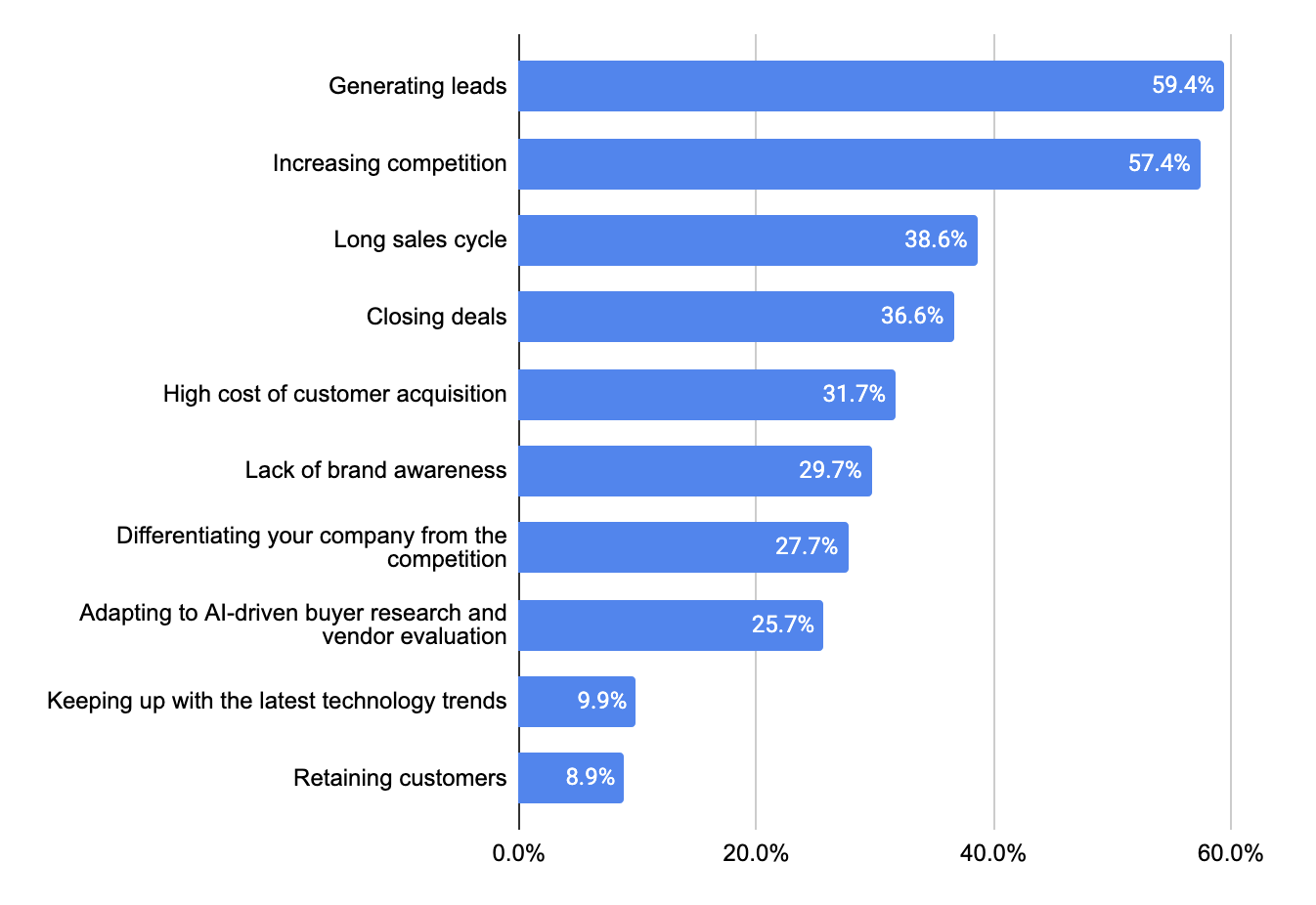
According to 59.4% of respondents, the biggest challenge IT services providers face in 2026 is generating leads. Increased competition is also causing difficulties, with 57.4% of respondents reporting this as problematic – especially in light of growing AI integration. Retaining customers is the lowest of providers’ concerns.
Distribution is becoming the main moat. Product quality still matters, but if you cannot reliably reach the right people, it does not compound. The advantage is shifting to teams that learn faster than competitors, with tight feedback loops, rapid creative iteration, and a willingness to test channels early. Most B2B marketing is still too polished and too slow. Authenticity and speed are underpriced. The teams that win will ship constantly, listen to the market, and double down on what earns real attention rather than what just looks good internally. – Mid-sized IT Services Company (50–99 employees), United States
Key Takeaways:
The two biggest challenges for IT services providers in 2026 are lead generation and competition. To get a handle on these challenges, companies will need to develop sharper positioning, more compelling proof points, and content that helps buyers get their heads around why they’re different.
In addition, now that AI-driven research is a part of the vendor evaluation process, agencies also need to make sure their expertise is easy to find, understand, and validate.
Comparison of the Biggest Challenges in Attracting New Customers
.webp)
Lead generation continues to be the top challenge for respondents in 2026 at 59.4%, but it’s still very low compared to 81.8% in 2023. The bigger shift is increased competition, which jumped from 43.5% in 2025 to 57.4% in 2026. This is a clear sign of a crowded market.
Keeping customers dropped sharply to just 8.9%, so it’s clear that providers are more concerned with winning new business than retaining existing clients.
Key Takeaways:
Customer acquisition is still the hardest part of growth, but the pressure has changed. Lead generation continues to be difficult, and it’s getting harder for IT services providers to differentiate themselves amid increased competition and AI-driven buyer behavior.
To compete, providers should invest in clearer positioning, stronger proof points, and content that supports the buyer’s research process before the sales conversation starts.
Current State of the IT Services Market’
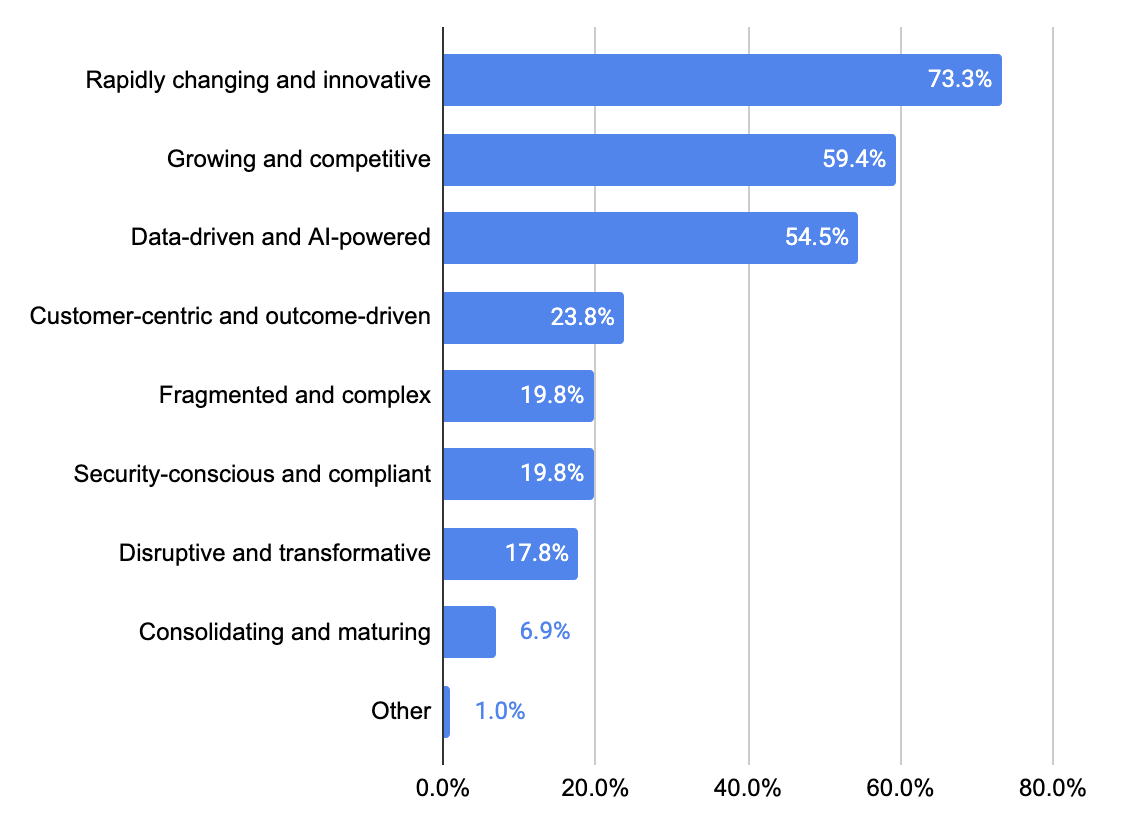
Respondents most often characterized the 2026 IT services market as rapidly changing and innovative (73.3%), followed by growing and competitive (59.4%) and data-driven & AI-powered (54.5%).
The results of this survey question reveal a market in the middle of a digital transformation, powered by AI and automation.
Key Takeaways:
The market is active and competitive, and it’s being redefined by AI-driven change. For IT services providers, the opportunity will be to move beyond simply talking about general innovation and clearly articulate how to help clients navigate that change.
Strong positioning should link these three things: technical expertise, AI and data capabilities, and measurable client value.
Comparison of the Current State of the IT Services Market
.webp)
The comparison shows a clear shift toward a faster-moving market in 2026. Rapidly changing and innovative rose to 73.3%, up from 61.3% in 2025 and 63.6% in 2023, making it the strongest description this year. Growing and competitive continues to be high at 59.4%, though it dropped from 71.0% in 2025. Data-driven and AI-powered held steady at 54.5%, matching its 2023 level and reinforcing how strongly AI continues to shape the market.
Key Takeaways:
IT services providers see the market as active, competitive, and increasingly shaped by AI. Companies may need to keep adapting their services, positioning, and marketing strategies around faster innovation and AI-driven buyer expectations.
Planned Marketing Investments for the Next Year
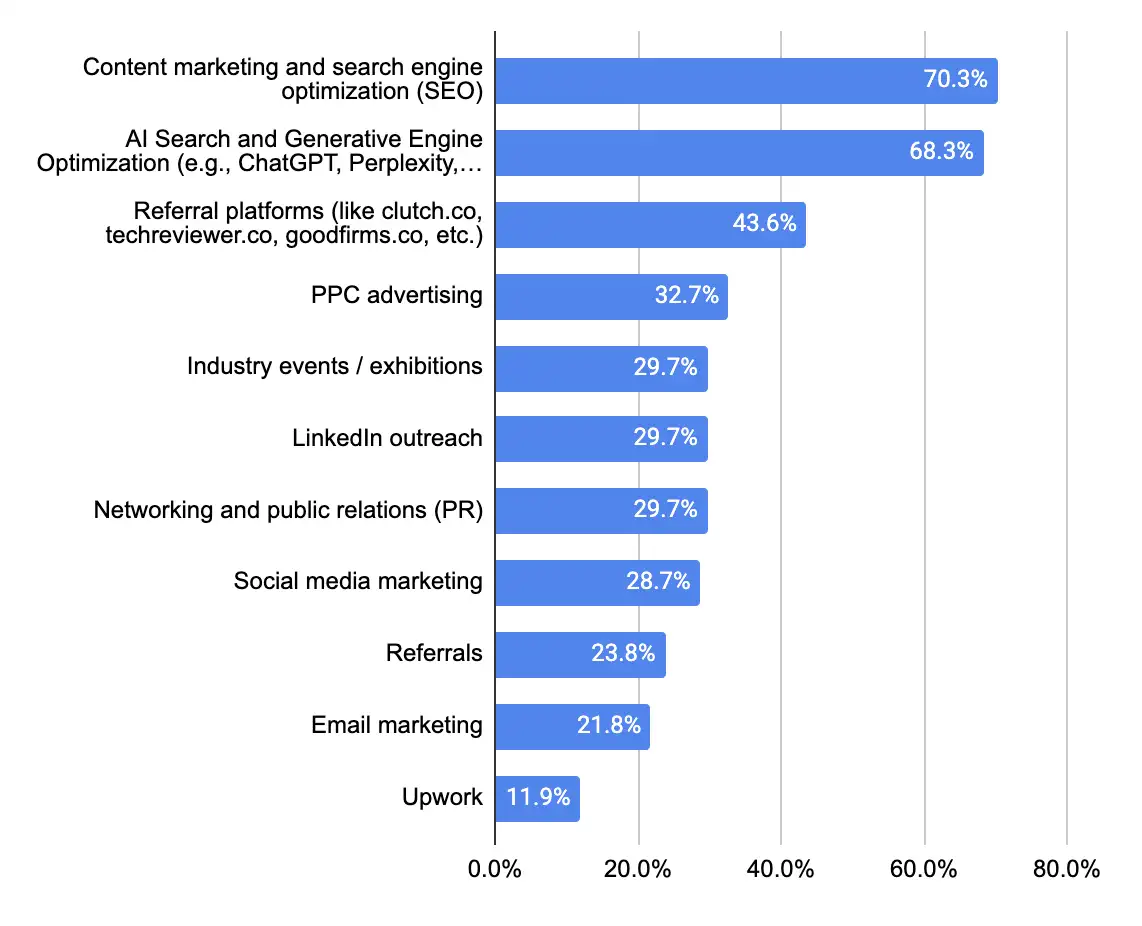
Techreviewer asked survey takers which marketing channels they planned to invest more in over the next year. Here’s what they planned, from highest to lowest investment:
- Content marketing and SEO: 70.3%
- AI Search and Generative Engine Optimization: 68.3%
- Referral platforms: 43.6%
- PPC advertising: 32.7%
- Industry events / exhibitions: 29.7%
- LinkedIn outreach: 29.7%
- Networking and PR: 29.7%
- Social media marketing: 28.7%
- Referrals: 23.8%
- Email marketing: 21.8%
- Upwork: 11.9%
Key Takeaways:
It’s easy to notice that there’s a big drive for visibility, as the bulk of respondents said they planned to spend big on content marketing, SEO, and AI search. But visibility will get crowded as everyone starts capitalizing on this trend.
A smart marketing plan should not simply follow the same patterns as everyone else. IT services providers should invest in channels that their target buyer personas are actually using to research, plus compare and validate vendors. This means creating content that supports both traditional search and AI-driven discovery.
Comparison of Planned Marketing Investments for the Next Year
.webp)
Content marketing and SEO returned as the top-planned marketing investment for the year at 70.3%, followed by AI Search and Generative Engine Optimization, which entered the 2026 survey at 68.3%. Planned investment in email marketing had the biggest drop, halving to 21.8% in 2026
Key Takeaways:
Future marketing investment is moving toward visibility in both traditional search and AI-assisted discovery. There’s increasing preparation for a journey in which prospects will use search engines and generative AI tools to source vendors, so IT services providers should prioritize content, SEO, and AI search while reviewing lower-growth channels like email to determine what role those will play in the buyer research journey.
Planned Investments vs. Most Effective Channels
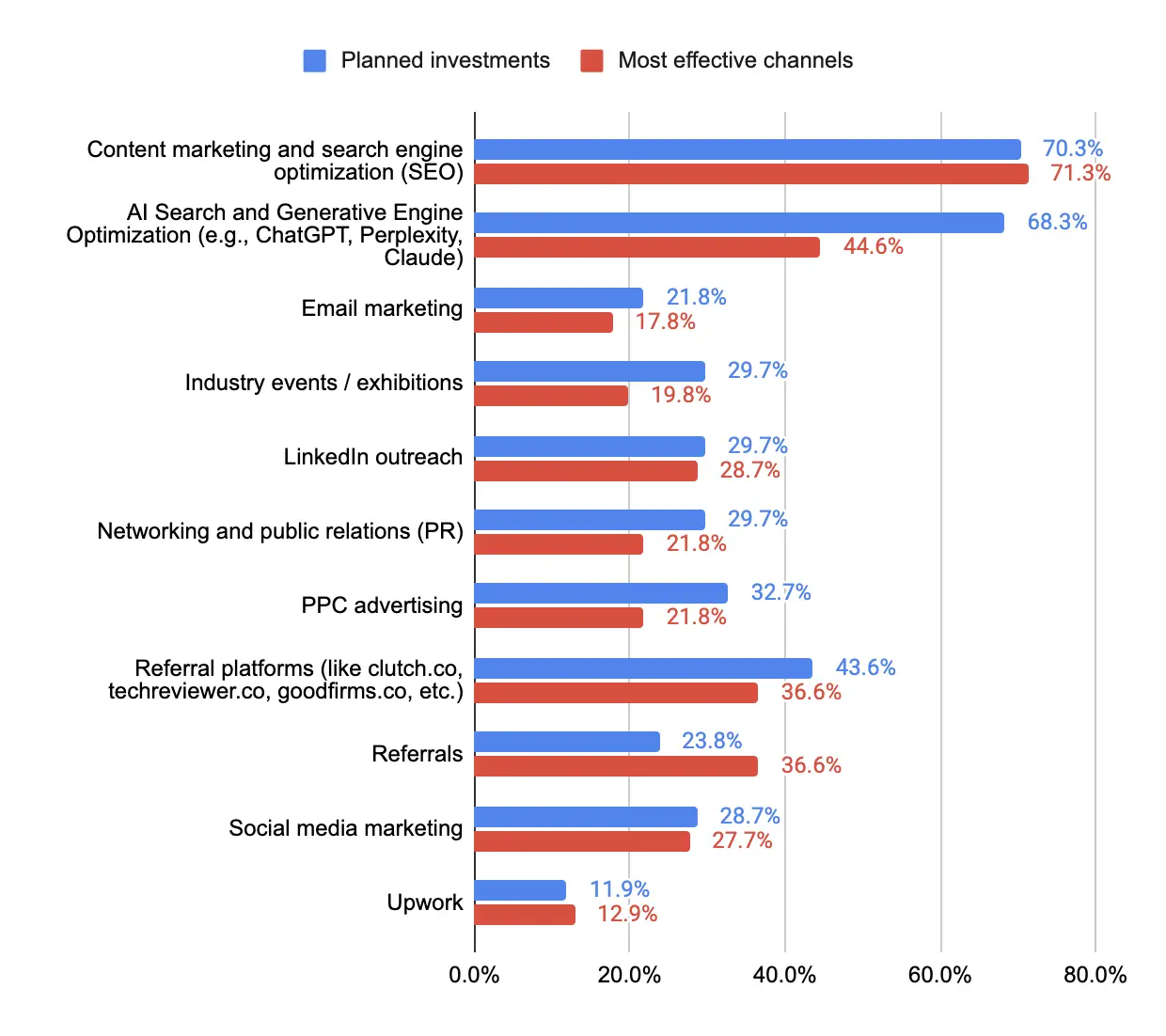
This comparison shows how planned marketing investment lines up with reported channel effectiveness.
- Content marketing and SEO: The strongest alignment is here, with 70.3% planning to invest more and 71.3% reporting it as effective.
- AI Search and Generative Engine Optimization: A forward-looking investment area, with 68.3% planning to invest more, compared to 44.6% reporting current effectiveness.
- Referral platforms: Continued investment remains strong at 43.6% versus 36.6% effectiveness.
- Referrals: Potentially an underused channel. Only 23.8% planned to invest more in referrals, even though 36.6% said they were effective.
- Upwork: Low planned investment (11.9%) and low effectiveness (12.9%), with limited impact overall.
- Email marketing: Also low on both measures, with 21.8% planned investment and 17.8% effectiveness.
We are planning to expand into AI-driven marketing strategies, including personalized outreach and predictive analytics. We are also exploring LinkedIn Ads at scale, video marketing (short-form and YouTube), and programmatic SEO. Additionally, we aim to implement account-based marketing (ABM) for high-value B2B clients and leverage marketing automation tools to improve lead nurturing and conversions. – Mid-sized IT Services Company (100–250 employees), United States
Key Takeaways:
Planned investment heavily involves content, SEO, and AI search, but it’s important to balance future bets with actual performance. AI search could prove to be an effective channel in the coming year, and testing it out makes sense, especially since planned investment is much higher than the current reported effectiveness. Referrals also deserve a look, since their effectiveness is higher than current investment plans suggest.
Planned Investments vs. Channels That Missed Expectations

This comparison shows where IT services providers plan to invest more and which channels have not lived up to expectations.
Some high and low points:
- Content marketing and SEO. This category has a strong positive gap. 70.3% plan to invest more, while just 13.9% say it hasn’t met expectations.
- AI Search and Generative Engine Optimization is behaving similarly, with 68.3% planning to invest more and only 16.8% being disappointed.
- Email marketing: The clearest warning sign is evident here. Only 21.8% plan to invest more in email marketing, but 41.6% say it hasn’t lived up to expectations.
- Social media marketing is another weak point: 28.7% plan to invest more, but 36.6% report disappointment.
Key Takeaways:
Channels tied to buyer discovery are attracting more investment and producing less disappointment, especially content marketing, SEO, and AI search. Email and social media tell a different story: both show higher dissatisfaction, so IT service providers should audit targeting, messaging, and conversion quality before putting more budget into them.
Biggest Threats Facing IT Services Providers in 2026
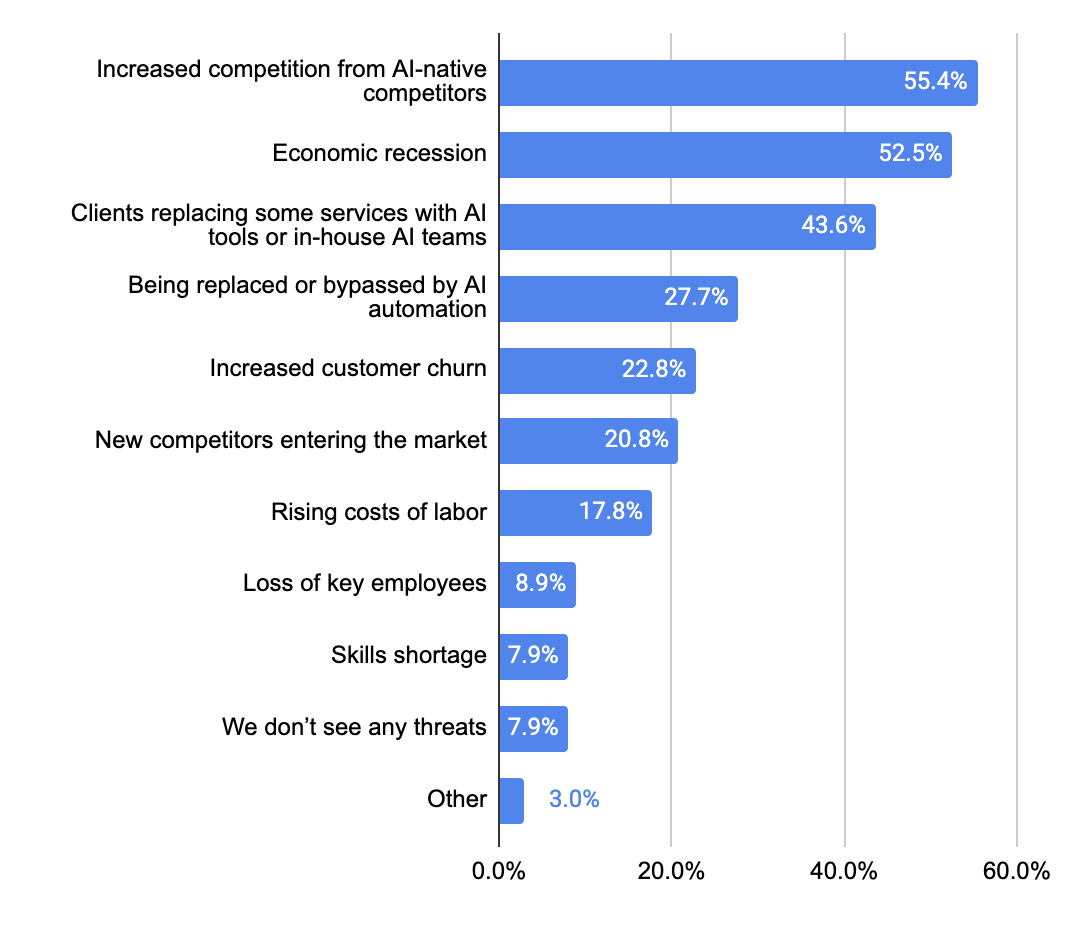
AI is the dominant threat to IT services providers surveyed. Increased competition from AI-native competitors (55.4%) is the top concern.
AI-related client behavior is also appearing as a major concern because respondents worry (43.6%) that clients will replace some offered services with AI tools or in-house AI teams. Being replaced by AI or bypassed by AI automation is also a major concern (27.7%).
Market data from Deloitte suggests that the number of companies with 40% or more of AI projects in production is expected to double within the next six months. With such rapid growth, IT services companies will likely face increasing pressure from AI-native competitors and AI tools.
Key Takeaways:
IT service providers should treat AI-native competition not just as a threat but also as an opportunity to incorporate AI into their service models. That could mean embedding AI-enabled tools in delivery; demonstrating the areas in which human expertise continues to mitigate risk; and structuring teams around strategy, judgment, integration and industry-specific problem solving.
Providers may also have to collaborate with AI platforms, develop AI advisory services, or support clients to implement AI responsibly rather than compete head-on with automation alone.
Comparison of Biggest Threats Facing IT Services Providers in 2026
Economic recession was the topmost threat in earlier surveys, cited by 75.8% of respondents in 2023 and 64.5% in 2025. By 2026, that concern dropped to 52.5%. The biggest threat in 2026 was increased competition from AI-native competitors. It led at 55.4%.
AI is also a factor in two other major 2026 concerns: 43.6% of respondents worry about clients replacing some services with AI tools or in-house AI teams, and 27.7% worry about being replaced or bypassed by AI automation. Traditional concerns like rising labor costs (17.8%), skills shortages (7.9%), and loss of key employees (8.9%) ranked much lower.
Key Takeaway:
AI disruption has become a strong threat signal to IT services providers, although economic recession is still a significant concern.
Conclusion
What We Learned from the 2026 Survey
Overall, 2026 data points to an IT services market heading into a more competitive, AI-driven phase. Buyers are doing more independent research, visibility is shifting to search and AI-assisted discovery, and providers are under more pressure to demonstrate expertise before a sales conversation even starts.
The most obvious tension is that traditional channels of acquisition are seemingly less reliable, while AI-native competitors are becoming more threatening. Email, PPC, LinkedIn outreach and social media still have a place but are noisier, more crowded and often more difficult to convert. Meanwhile, content marketing, SEO, AI search, referrals and convincing proof points are growing in importance because they allow buyers to evaluate providers on their own terms.
The bigger takeaway here is that IT service providers can’t compete on visibility. They need sharper positioning, clearer evidence of quality, and better explanation of how human expertise, technical judgment, and AI-enabled service delivery work together. The companies that adapt the fastest are likely to be the ones that become easy to trust and hard to replace.
Strategic Recommendations
- With so many more buyers researching providers using generative AI tools, make content marketing, SEO and AI search central pillars of your marketing strategy.
- Referrals are traditionally an effective way to gain trust from potential buyers. You can work to generate stronger trust signals through referral platforms, customer reviews, case studies, testimonials, and clear proof of expertise.
- Before you allocate more marketing spend, reassess your spending on lower-performing channels like email marketing, social media, PPC advertising, and Upwork.
- Build differentiators by communicating your expertise, service quality, and AI capabilities.
- As you prepare for AI-driven competition, make sure to adapt your service offerings and develop human expertise that drives value outside of automation.
Some of the companies that participated in the survey:
Scalo, Quantum IT Innovation, Sigli, Codeavour, Polcode, Troy Web Consulting, Sketch, MindInventory, Moon Technolabs, Seedium, BitBreeze, Zaavia, Workspace, Innov8world, Freshcode, SPLIT Development, Tuvoc Technologies, SEIDOR Opentrends, Significa, One Beyond, DataRoot Labs, Timspark, NIX, Kevych Solutions, Bluelinks, Decipher Zone Technologies, Zfort Group, Aetsoft, Cloudester Software, Intelliarts, Censony, Easify Technologies, Betlace, ND Labs, DigitalMonk, Master of Code Global, Adamo Software, End Point Dev, Technaureus Info Solutions, Vetnion, Budventure Technologies, Onix, Differenz System, Bits Orchestra, LimaRank, CleverDev Software, IIH Global, Saritasa, FlairsTech, Local Data Exchange, Softellar, Airteam, Impala Intech, Atta Systems, Ein-des-Ein, Clicta Digital, TestFort, Cabot Technology Solutions, Sylnovia, Tech.us, Simplico, launchOptions, Kalp Technocrats, Pennine Technolabs, BugRaptors, American Design Hub, ThulirSoft, Nesa Software, FIX Solutions, Web3Marketo, Dualboot Partners, Mindrops, WPRiders, Dignizant, Mxicoders, DevStory, Graphiters