Advancements in Automotive Software Development: AI for Autonomous Driving and Predictive Maintenance
The automotive sector is experiencing a rapid transformation. Modern automobiles, unlike traditional ones, are no longer just mechanical devices; they are advanced, connected systems operated by artificial intelligence and sophisticated software. Cars now basically think, learn, and communicate through data, sensors, and algorithms rather than gears and mechanical linkages.
The change is such that it is even bringing a new definition to mobility. Software development in the automotive industry has especially focused on AI-driven perception, decision-making, and automation as the main contributors to how a vehicle interprets its environment, responds to the road, and protects passengers.
As a result, automotive software development has become as critical as engine design or manufacturing quality.
The ongoing evolution in the IT sector of the automotive industry according to McKinsey is expected to drive the global automotive AI market to 4.5 percent CAGR by 2035, mainly due to strong demand for autonomous driving, predictive maintenance, and next-generation safety systems.
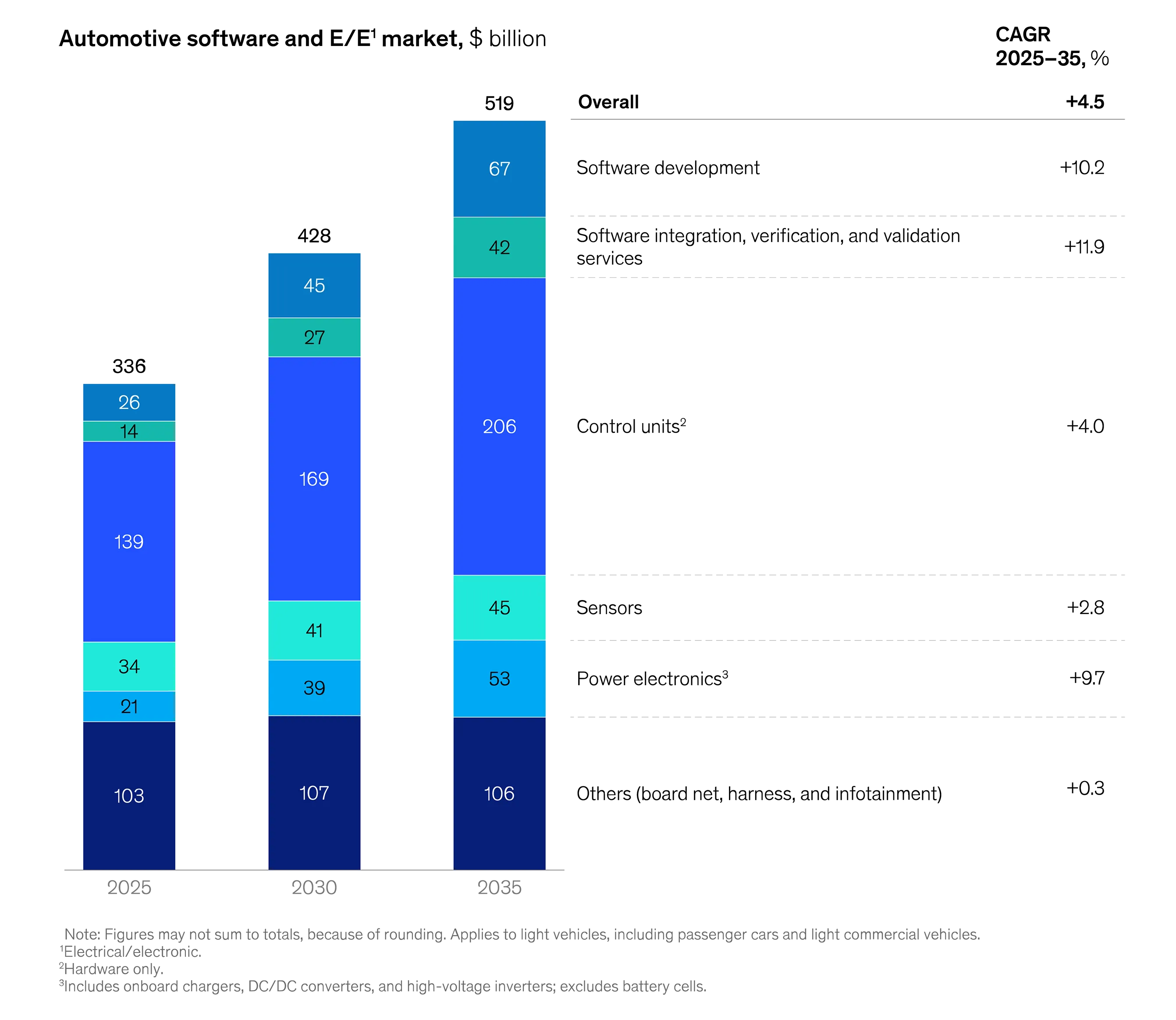
At the same time, this rapid transformation is made possible through a multitude of challenges. The car manufacturers are under constant pressure from:
- Cybersecurity threats that are increasing day by day
- The huge requirement for processing real-time data
- Diverse countries with different regulations and compliance that are hard to keep up with
- Ensuring the safety of all the connected vehicles that run into the millions
- The issue of ethics in making automated decisions
The solutions to the above-mentioned problems would require more than the conventional engineering practices. It would take software development for the automotive industry that can automate decision-making, predict failures, adapt to changing environments, and continuously improve through learning from real-world experience.
The Evolution of Automotive Software Architecture
From Mechanical Systems to Centralized Computing
Under the hood of a modern car, you’ll find less wiring and more computing power. The days when every function – ignition, brakes, air conditioning – ran on its own separate module are long gone.
Today’s vehicles run on centralized computing architectures, where a few high-performance processors control almost everything. This design makes cars faster, smarter, and easier to upgrade. When an automaker improves a safety algorithm, for example, it can instantly roll out the update to millions of vehicles worldwide – no mechanic required.
Over-the-Air (OTA) Updates: Software That Evolves Your Car
That’s possible thanks to over-the-air (OTA) updates, the same kind your smartphone gets. Tesla may have started it, but now every major brand – from BMW to Ford – uses OTA technology. You can literally wake up one morning to find your car drives more efficiently or has a new feature.
Software-Defined Vehicle (SDV)
This represents the rise of the software-defined vehicle (SDV), in which software not only supports hardware but also defines it. A vehicle’s performance, safety, and even personality now evolve through code rather than components. For drivers, this shift means convenience and fundamentally changes how we interact with cars; a decade ago, cars were tools – now, they are closer to co-pilots.
OTA updates help:
- Deliver instant safety patches and bug fixes.
- Add new features without dealership visits.
- Improve driving efficiency and vehicle performance.
- Lower long-term maintenance costs.
- Keep millions of vehicles up to date with the latest software.
Personalization Powered by Machine Learning
Step inside a modern EV and you’ll notice how intuitive everything feels. The car recognizes your face or your smartphone, sets the lighting to your preference, warms your seat if it’s cold outside, and maps the best route home – all without being asked.
That personalization is the result of machine learning working quietly in the background. Personalization can:
- Learns route preferences and driving habits.
- Automatically adjusts lighting, HVAC, and seating.
- Remembers entertainment choices.
- Predicts commonly visited locations.
- Suggests optimal travel times based on your patterns.
Every command, every trip, every button press feeds the car’s algorithms, helping it understand what you like and when you like it. It’s the same principle that powers Netflix recommendations – only now it’s keeping you comfortable at 100 km/h.
How Automakers Are Transforming Into Software Companies
Behind this evolution is a massive industrial shift. Traditional automakers were built around hardware expertise – engines, steel, and assembly lines. Today, they’re racing to become software companies. Previously, manufacturing mechanical parts, factories now depend on AI experts and embedded systems engineers. Instead of outsourcing, companies like Stellantis and Volkswagen have established in-house tech hubs to write their own code.
As a result, software development has become as essential as mechanical engineering in automotive operations. Manufacturers now hire AI experts, cloud engineers, and embedded developers in greater numbers than ever before.
Supply Chain Evolution: From Hardware to Code
The supply chain is also evolving. Instead of shipping bolts and bearings, suppliers deliver code libraries and algorithm updates. In many ways, “manufacturing” a car today means compiling software as much as it means welding metal.
The Rise of Empathetic and Human-Centric Automotive Software
The shift toward intelligent software isn’t only about automation – it’s about empathy. Automakers are beginning to design systems that understand and respond to human emotion, comfort, and behavior. The new frontier of car software is less mechanical and more psychological.
For example, devices in the cabin that monitor pulse, eye movement, and skin temperature are used to assess drivers' health. The data, along with the AI, will empower the cars to detect the feelings and make the necessary changes immediately.
During the peak hour, your vehicle may resort to music that calms you down, and change the ambience or slightly alter the steering distance to help you cope better with the situation.
This “empathetic AI” approach turns cars into wellness spaces on wheels. Lexus and Hyundai have both showcased concept vehicles that monitor biometric data and adjust cabin environments to enhance focus or relaxation. It’s a natural extension of predictive maintenance – but applied to people instead of parts.
Modern Vehicles for Access and Disability Design
Accessibility is one of the areas that human-centric design prioritizes. Software-powered interfaces have already provided users with control through speech, personalized layouts for people with disabilities, and simplified dashboards that self-adjust to the user’s requirements. The new generation of cars will not force humans to adapt to technology; rather, they will adapt to us.
The Role of AI in Autonomous Driving
AI is one of the innovations that could maintain the same level of power as self-driving cars. It would be like putting a brain into the car that could see, understand, and respond simultaneously.
AI enables autonomous driving through:
- Perception: Different types of sensors, such as cameras, radar, and lidar, bring the first data to the AI in the most basic form.
- Understanding: The system recognizes objects in the scene and identifies entities such as vehicles, people, road signs, and barriers.
- Prediction: The models foresee the next movements or actions of every entity involved.
- Decision-making: The system chooses the safest action
- Control: Executes steering, braking, and acceleration instantly
Modern automotive technologies capable of operating independently are supported by these processes, which use sophisticated automotive middleware such as ROS 2 (Robot Operating System), AUTOSAR Adaptive, NVIDIA DriveWorks, and Baidu's Apollo.
These infrastructures control the input from sensors, the interaction among modules, and the behavior of the real-time system, thereby rendering the contemporary autonomous architecture trustworthy and expandable.
Real-World Capabilities of Automotive AI
The car manufacturers Tesla, Waymo, and Cruise continue to upgrade their autonomous vehicles through extensive data collection and analysis. The state-of-the-art AI, nevertheless, comes along with these capabilities:
- A major decrease in accidents that are a result of human error.
- Traffic and weather are considered when planning faster, more efficient routes.
- Elderly, disabled, or inexperienced drivers are safely assisted through navigation.
Although we are still at the very beginning of the whole autonomy era, every software update would indeed bring us closer to cars capable of driving themselves.
In simpler terms, just imagine a roundabout with the maximum possible traffic; the human drivers will rely on their sight and intuition, while the AI car will rely on its hundreds of sensors that create a digital representation of the environment around it.
How AI Understands the Environment
In complex scenarios – like a crowded roundabout – humans rely on judgment and experience.
An autonomous vehicle, however, uses:
- Computer vision technology addresses the challenge of processing vast amounts of pixel data and detecting lanes, objects, and movements.
- Sensor-fusion technology that integrates radar, lidar, and camera inputs and presents a unified 3D view.
For example, Waymo's cars can handle almost 1 GB of data from their sensors every second. This identifies an object as a biker, a person, or just a flying plastic bag, and also predicts its movement. Such a high degree of perception of the surrounding area allows AI to react more quickly than any human driver.
Each car now carries dedicated AI chips that handle calculations locally. These processors, from companies like NVIDIA and Qualcomm, can perform billions of operations per second, enabling the vehicle to respond instantly even without internet access.
Why Edge Computing Matters
Edge computing lets an autonomous car slam on the brakes when a dog darts into the street – no time is lost sending data to the cloud and back.
But giving machines control also means giving them moral responsibility. Engineers now face the toughest question in technology: How should an AI decide between two bad options?
Ethical and Regulatory Considerations
This “trolley problem” isn’t just philosophical – it’s regulatory. A machine that makes the final word on life-and-death issues is an ethical dilemma of great magnitude. Countries globally are coming up with regulations that put forward three basic principles as the main focus:
- In any situation, human life should be given the highest importance.
- AI's decision-making process should be clear and easy to follow.
- Responsibility must be linked and supported by event logs and “black-box” records.
Germany, Japan, the EU, and the United States are developing the rules that allow for innovation, but at the same time protect the public. In the event of an accident, automakers will have to provide a record of the AI's decisions so investigators can have a clear picture of the incident.
How AI Is Reshaping Automotive Careers
This digital revolution is transforming not only cars, but careers. The automotive industry now hires more coders than carburetor specialists. In fact, software engineers are becoming as essential as mechanical engineers once were.
Companies like Ford and Toyota are retraining thousands of staff to handle cloud systems, embedded code, and AI model management. Many universities have launched automotive data science programs to meet demand.
In the future, these workshops will look more like technological laboratories than ordinary garages. Rather than using wrenches, technicians will use laptops to identify the problems with the cars. Many of the repairs will be made by applying patches rather than replacing entire components. That change is fuelled by a cultural revolution, enabled by technology working with artistry to create future vehicles.
AI-Driven Predictive Maintenance in Vehicles
Modern automobiles can gather thousands of data points every minute. Predictive maintenance software applies this data to detect early signs of trouble – a vibration, a drop in battery voltage, a slight change in oil pressure – long before a breakdown occurs.
How Predictive Maintenance Works
Your car will not even let you be inconvenienced by the failure; it will notify you in advance, or even schedule maintenance automatically. This would mean fewer interruptions and lower repair costs for fleet managers and everyday consumers enjoying a worry-free experience.
Some examples of data predictive maintenance monitors include:
- Abrupt vibrations or sudden engine noises
- Fluctuations in battery voltage
- Tire pressure deviations
- Oil pressure or temperature anomalies
- Motor and inverter temperatures (EV-specific)
Automakers like Ford, Bosch, and Volvo are quite ahead in the game and utilizing these systems to enhance vehicle life and safety. Just think of it as an in-house doctor for your car – one that’s always keeping an eye on your vehicle’s fitness.
The Role of Custom Automotive Software Development
Typically, manufacturers collaborate with the top-notch custom automotive software development companies that build the entire AI ecosystems right from the beginning, including:
- Integrated IoT sensors
- Edge-computing hardware
- Cloud-based analytics platforms
- Vehicle-specific AI models and dashboards
This enables highly personalized maintenance logic tailored to each vehicle platform.
A Real-World Example
Envision a scenario where you are heading back home and your dashboard illuminates – not on account of any malfunction, but rather your car's AI is predicting that the alternator will go out after 300 miles. It then instantly contacts your designated garage, inquires about available slots, and proposes a time that is convenient for you.
That’s not science fiction – that’s happening right now in premium fleets and electric vehicles.
Real Results from Leading Automakers
- Volvo Trucks uses AI supported by telematics to anticipate wear on brake pads, wheels, and the gearbox.
- The Ford F-150 Lightning automatically regulates battery temperature and optimizes charging cycles, prolonging battery life by up to 15%.
For fleet operators, predictive maintenance can increase vehicle uptime by over 30% and significantly reduce overall maintenance expenditure.
Sustainability Benefits
Another benefit is sustainability. Predictive maintenance improves sustainability by:
- Optimizing engine and EV power usage
- Reducing unnecessary part replacements
- Minimizing idle time and fuel waste
- Extending battery life through balanced charge cycles
- Helping lower industry-wide CO₂ emissions by up to 10%
According to the European Environment Agency, if predictive technologies were incorporated into all new cars, the automotive industry's carbon dioxide emissions would decrease by 10%. Multiply that by hundreds of millions of cars, and you have a significant environmental impact – achieved not by building new infrastructure, but by using smarter software.
AI and the Future of Sustainable Mobility
AI remains the backbone of sustainability. Not only does the intelligent routing optimization algorithm reduce idle time for delivery fleets, but real-time engine monitoring also reduces the total amount of fuel wasted. In electric vehicles, predictive software determines power output to maintain both range and battery life.
Sustainability algorithms are increasingly adopted by manufacturers at the very beginning of the design process, as AI is applied to test the efficiency of the draft and the material's environmental impact before a single prototype is made. As a result, there is less waste and quicker development periods.
Enabling Technologies Behind Predictive Maintenance
Even predictive analytics can forecast demand for charging stations, allowing cities to plan for an eco-friendly infrastructure with greater efficiency. One can say that with the integration of smarter software, every journey is a tiny step towards saving the earth.
These features are enabled by custom automotive software development, which introduces AI models, sensor integrations, and predictive analytics tailored to each vehicle platform's needs.
Integration Challenges and Solutions
Smart vehicles are going to contribute more data, and with that, also a doubled concern about who is in control, how it will be managed, and how it will be protected.
Data Protection and Cybersecurity Pressures
The spectrum of connected cars encompasses infrastructure that consumes almost one terabyte of data per day, including information about where vehicles are located, their drivers' profiles, and their driving styles.
Thus, car makers are under a lot of pressure to protect this data from sinful intrusions and losses – they have to do this through a combination of techniques such as:
- End-to-end encryption for secure data transfer.
- Blockchain validation for tamper-proof update logs.
- Cybersecurity audits and penetration testing are done continuously.
- Firewalls and intrusion-detection systems of automotive grade.
Brands also partner with digital payment security providers, such as Paysafe, to help handle sensitive transactions across their digital ecosystems.
Researchers managed to remotely take control of a Jeep Cherokee back in 2015, but only through the vehicle's infotainment system; they could control steering and braking while the car was moving on the highway. It shocked the world – and forced the industry to act.
Since then, cybersecurity has been considered the primary factor in the design of automotive software. Car manufacturers have also recruited ethical hackers and included penetration testing in every new release. Many vehicles have intrusion-detection systems that monitor for unusual network traffic, much like antivirus software running on a computer.
Emerging Threats in a Connected Ecosystem
New risks are regularly appearing, which cannot be ignored. With the development of vehicle-to-infrastructure communication, an attack could affect the entire fleet or city network. Major cybersecurity risks include:
- Remote hacking through infotainment systems
- Manipulation of steering or braking controls
- Malicious OTA updates
- GPS spoofing and location manipulation
- Unauthorized access to driver behavior data
That’s why many manufacturers are adopting blockchain-based logs – tamper-proof records that track every software update and data exchange.
Scalability Challenges: Edge vs Cloud Computing
The deployment of intelligent algorithms in autonomous vehicles requires a fine adjustment between edge computing (processing on the vehicle) and cloud computing (centralized model updates and fleet intelligence). Some of the main issues related to scalability are:
- Model Deployment at Scale: The transfer of updated AI models to millions of vehicles must be efficient, secure, and account for the volume of data transferred. In the case of neural networks, their size can reach several gigabytes, which makes it impossible to do over-the-air (OTA) deployments that are huge in scale.
- Bandwidth and Latency Limits: Even with highly compressed models and sensor data, communication links still require substantial bandwidth, which is a constraint. Poor connectivity may slow the process of sending updates to vehicles.
- Edge Hardware Variability: Various vehicle generations and trim levels may use different chipsets, requiring that the model for a single vehicle be modified to account for the specific hardware capabilities.
To tackle scalability issues, automakers are turning to federated learning, a technique in which vehicles train AI models using their own data, with only anonymous updates sent to the central server. This:
- Lessens the data transfer needs
- Protects the privacy of drivers
- Enables the global model to be continuously improved without the need for raw vehicle data to be exposed
Federated learning is positioned as the foundation for large-scale vehicle intelligence.
Regulations, Transparency, and Explainable AI
Various international regulations, such as ISO 26262-1:2018 and UNECE WP.29, do provide guidelines on safety and cybersecurity, but public trust will still rely on another factor – transparency. Car users must be informed about when and how AI technologies participate in decision-making, and what happens to their data afterward.
Data ownership is becoming the next frontier. Cars can now record information about where we have been, the speeds we were traveling, and the music we listened to. Should that information belong to you – or the manufacturer?
Several global regulations have responded to the risks of automotive AI.
- United States (NHTSA): Developing safety reporting standards
- European Union (AI Act): Enforcing strict risk classification rules
- Japan: Leading ethical guidelines for AI road safety
- South Korea: Establishing high transparency and accountability frameworks
However, with these regulations, manufacturers will have to be careful not to let compliance with the law stifle innovation. For instance, software updates must go through safety certifications, while AI actions must be traceable. Transparency isn’t just good ethics – it’s good business. Drivers are far more likely to trust a system that can explain itself.
Industry Case Studies
Real-world scenarios showcase the application of AI, predictive analytics, and advanced software architecture not only by technology companies but also by automakers in modern mobility transformations.
Notably, these case studies demonstrate the impact of intelligent software in practice – not only in models or laboratories but also in vehicles currently operating on public roads.
Case Study 1: Tesla – Continuous Learning Through OTA Updates
Tesla's fleet has become one of the largest sources of real-world data on autonomous driving. Every vehicle sends back anonymized driving data that helps refine Tesla's neural networks. The company frequently releases over-the-air (OTA) updates that improve Autopilot, adjust Full Self-Driving (FSD) behavior, and refine energy consumption.
This approach of an AI lab that is always on has enabled Tesla to implement changes to navigation, emergency braking, lane keeping, and object recognition faster than traditional automotive development cycles.
Case Study 2: Waymo – High-Fidelity Perception and Autonomous Ride-Hailing
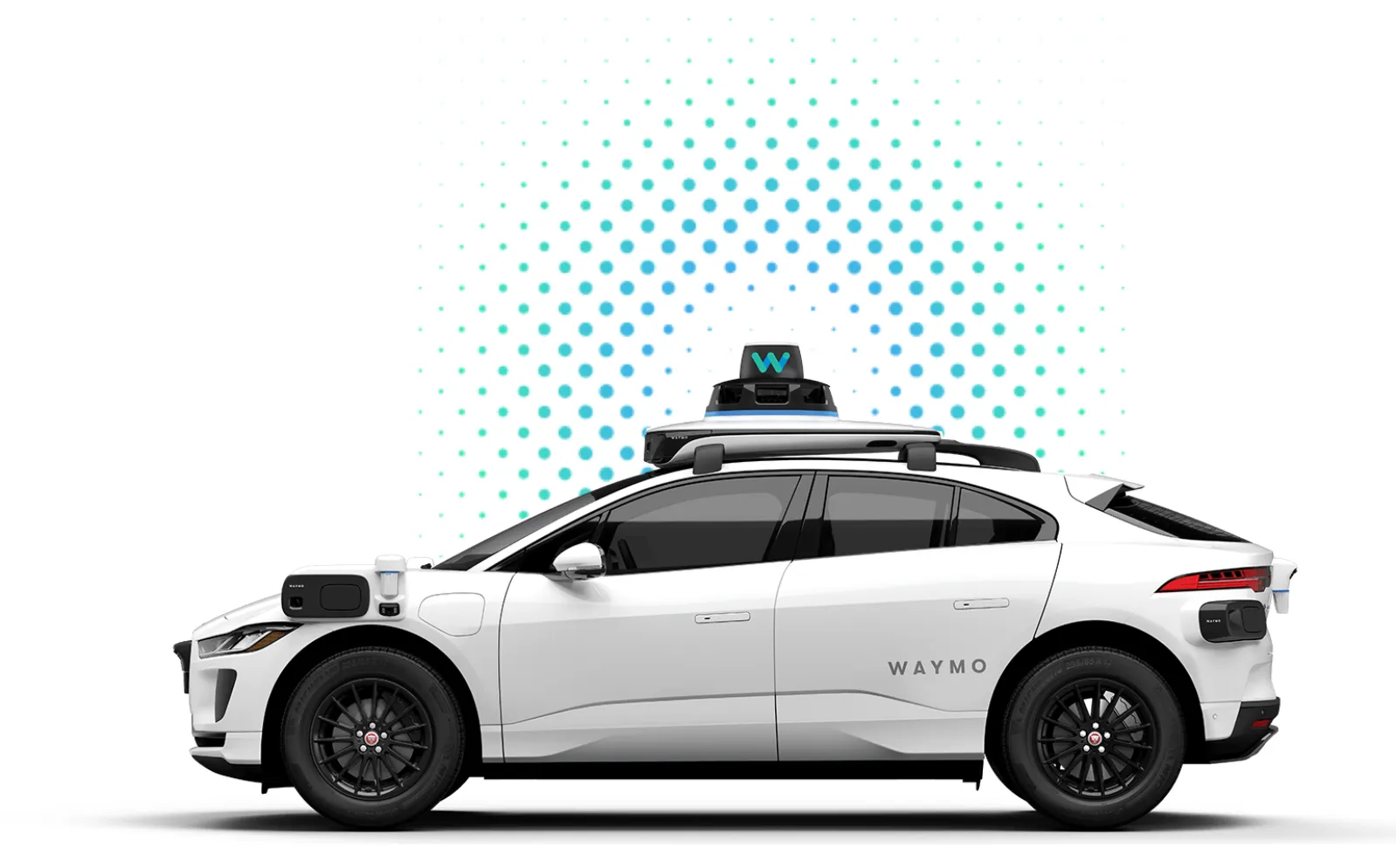
The Waymo robotaxi fleet is an example of the industry's most sophisticated perception and sensor-fusion systems. Waymo's autonomous vehicles can process around 1GB of sensor data per second and differentiate objects with astonishing accuracy.
In Phoenix, San Francisco, and Los Angeles, Waymo offers fully driverless rides, demonstrating that AI-powered mobility can be done safely and at scale, even in challenging urban settings. Their software, built on high-resolution lidar, radar, cameras, and deep learning, has set a standard for Level 4 autonomy.
Case Study 3: Volvo Trucks – Predictive Maintenance that Reduces Downtime
Volvo Trucks employs telematics-based AI to monitor the performance of its commercial fleets. The system recognizes the earliest signs of deterioration in parts by processing trillions of data points collected from braking systems, transmissions, and wheels.
The service centers are informed about the problems several days or weeks in advance, so they can schedule repairs on time. The fleet operators say their vehicles are more available, maintenance costs are lower, and operations are safer – all thanks to predictive analytics and connected diagnostics.
Case Study 4: Toyota Middleware and Scalable Autonomous Architecture
Toyota’s collaborations with NVIDIA and the integration of middleware frameworks have greatly sped up the company’s autonomous car development. Toyota is constructing interchangeable systems that can be applied to various automobile models by the use of ROS 2, AUTOSAR Adaptive, and high-performance AI compute platforms.
With this kind of system in place, Toyota can enhance perception and planning algorithms without completely scrapping the existing system – this feature helps secure long-term scalability and the efficient deployment of new technologies.
Future Trends and Innovations
Autonomous driving is not the only thing in the future; there will also be a lot of smart, predictive, and very personalized driving.
Hyper-Personalized Driving Experiences
Just think of a vehicle that understands your needs. A smart vehicle will be able to:
- Set seats, mirrors, and climate to preferred settings.
- Select music based on mood or time of day.
- Anticipate traffic conditions before you leave.
- Adjust lighting, sound, and even power output to match your mood.
These adaptive features will turn cars into intelligent, mood-aware personal spaces.
Connected Mobility Through 5G and 6G
Meanwhile, 5G and upcoming 6G networks will allow cars to “talk” to each other and to the infrastructure around them, creating safer, synchronized traffic systems.
Automakers are also exploring subscription models – offering new features like heated seats, advanced parking, or driver-assist tools as on-demand upgrades. Software will become the bridge between the physical and digital worlds of driving. In the near future, cars won’t just move through cities – they’ll help manage them.
V2X and Smart City Integration
Urban planners have begun to combine V2X (vehicle-to-everything) technologies with smart traffic lights and tolling systems to:
- Coordinate with adaptive traffic lights.
- Automatically prioritize emergency vehicles.
- Adjust public transport scheduling.
- Detect and report road hazards instantly.
- Reduce congestion through synchronized routing.
This will result in fewer traffic snags and more comfortable trips for daily travelers. Thus, for urban areas, it is a change in efficiency that makes the millions of cars used as sensors to regulate the city’s pulse.
Software-as-a-Service (SaaS) Vehicle Models
Once a car leaves the dealership, its relationship with the manufacturer usually ends. Now it’s just beginning.
The model of ownership is being shifted by automakers such as Tesla, BMW, and Mercedes through a software-as-a-service model, which:
- Creates recurring revenue streams
- Allows drivers to customize features month-to-month
- Reduces upfront car purchase pricing
- Enables on-demand upgrades (heated seats, ADAS tools, etc.)
Cross-Industry Partnerships Driving Innovation
No single company can cover all areas of AI, robotics, and cloud computing. Automotive industry companies are forming up, especially through tech giant and start-up partnerships, and are no longer relying on tech firms for all their needs.
Notable partnerships include:
- Volkswagen + AWS – real-time factory and production data processing.
- Toyota + NVIDIA – advanced AI compute for self-driving systems.
- Mobileye, Cruise, Aurora – perception stacks for Level 4 autonomy.
This has led to an automotive ecosystem that is no longer competitive solely on technological innovation. Companies do not have to collaborate through ecosystems; they remain siloed.
The decade that follows will be the era of partnerships. Car manufacturers, chip makers, telecom companies, and cloud service providers are teaming up. The automakers are just following their respective paths: the GM path of collaborating with Google Cloud to analyze the connected vehicle data or the Hyundai path of relying on AWS for AI-assisted logistics.
New Software-Driven Mobility Services
The triumph of these partnerships is manifested in faster innovation, fewer overlaps, and the creation of new industry standards. AI will open new services in the field of automotive software, such as:
- Self-driving vehicle-sharing fleets
- Dynamic, usage-based insurance policies
- Proactive city-wide road maintenance alerts
- Energy-optimized electric vehicle charging cycles
- Hyper-personalized in-car wellness features
Unified Digital Mobility Infrastructure
Ultimately, the future data-sharing model may drive universal digital infrastructure, enabling seamless collaboration among automobiles, urban areas, and electricity networks.
The result? A smarter, safer, and more sustainable transportation network where cars aren’t just products – they’re participants in a global digital conversation.
Conclusion
The automotive industry is moving toward a future where software controls the intelligence, performance, and safety of vehicles, not hardware. AI, predictive analytics, and advanced automotive software development are the factors behind the transformation of cars into intelligent, connected, and self-learning machines.
The vehicles that were previously not connected are now part of a larger digital ecosystem, where they learn from real-time data, communicate with the infrastructure, and adapt very accurately to drivers' needs. The changeover is paving the way for the transportation sector to be not only the safest but also the most eco-friendly and most customized ever.
Besides that, it introduces more obligations, such as protecting data, being open, and creating AI systems that make moral and intelligible choices. Trust and innovation, being, to a large extent, the manufacturers' capability, will determine the pace of adoption.
In the future, the combination of AI, cloud computing, V2X communication, and federated learning will make mobility a smooth, predictive experience – cars won't just be machines anymore, they will be the road's smart partners.
Software has taken the lead in the development race, and it will shape the next generation of mobility.